
The transnational “elite” want to impose climate lockdowns but realise they’ll be resisted by the public, so they’ve implemented a strategy of deception.
Rather than telling the truth about their plans to restrict people’s mobility and trap them in 15-minute cities, they’re sneaking in these policies by the back door.
Bogus pretexts are deployed to gain wider support for measures creating the foundations for climate lockdowns.
They created an air pollution scare and spread disinformation about the impact of car fumes on health. This provided a pretext to impose “low emission zones” and force lower-income motorists off the roads.
It also allowed the authorities to install infrastructure that can be repurposed for the long-planned system of road charging, as well as conditioning the public to the idea of paying tolls to enter certain areas.
Another strategy was to manipulate local political systems in order to impose “low-traffic neighbourhoods”. Many of the big losers from such policies lived outside the boroughs concerned, so had little say in the matter. So-called consultations were often rigged or ignored.
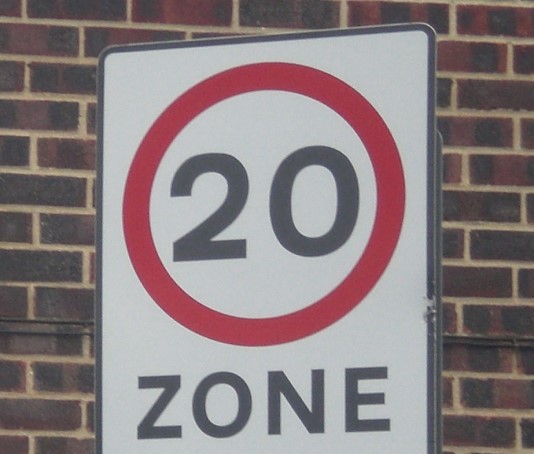
The focus of this article is a third ruse to advance the climate lockdowns agenda: the lowering of speed limits and the imposition of 20mph zones across the UK, 30km/h ones across Europe.
The authorities claim it’s about saving lives. Conveniently, this allows them to paint opponents of this policy in a very bad light, as not caring about victims of road accidents, including children.
But the perpetrators of 20mph zones are guilty of gross hypocrisy on this issue. Every second counts for victims of heart attacks and strokes. Yet the very same interests that promote 20mph policies have slowed down ambulances with a host of anti-car policies: cycle lanes or wider pavements that make roads too narrow to overtake the traffic; LTN road closures that force emergency vehicles to take a longer route; road humps and chicanes; cameras and fines that make drivers hesitant about getting out of the way at junctions; the proliferation of traffic lights that cause vehicles to bunch up; and so on.
Anti-car policies are counterproductive in other ways, too. They may encourage travellers to switch to more dangerous modes, such as riding motorbikes – a rational strategy to reduce the delays from artificially created congestion and lower the cost of the supertax imposed on fuel.
Moreover, investment in new roads historically played a major role in reducing casualty rates. The construction of motorways and dual carriageways took traffic away from relatively dangerous single carriageway rural roads. However, following the Conservative Party’s adoption of the radical green agenda, the roads programme largely ended in the mid-1990s.
Beyond the hypocrisy of their other policies, the 20mph brigade typically fail to acknowledge the economic trade-offs of lower speed limits. This is a classic example of focusing on the seen benefits while ignoring the unseen costs.
Lowering speed limits tends to reduce productivity. To take a simple example, a delivery driver might now be able to drop off nine items during his shift, rather than ten previously. Or consider labour mobility. A potential employee will be able to reach fewer job opportunities within a reasonable travel time. This makes it less likely he’ll get a job that matches his talents and also more likely he’ll stay unemployed. Then there are the lost economies of scale for businesses when they operate with smaller catchment areas, and so on.
Reduced productivity means fewer resources available for other goods, including healthcare, food, leisure activities and sanitation. In other words, 20mph zones have the potential to backfire, including in terms of saving lives, due to their negative impact on the economy.
The Welsh government’s own analysis of its 20mph policy estimated the costs of slower journey times at £6.35 billion over the 30-year appraisal period (2022 prices). This far exceeded the estimated road safety benefits of £1.39 billion.
Wales has a population of about three million. So, the cost of similar 20mph policies across the UK as a whole could well run into several billion pounds per year. And this is just one facet of the climate lockdowns agenda. Slower journeys and reduced mobility have major economic costs, as explained in detail in this article.
Even if we take the “saving lives” rationale at face value, it seems implausible that current 20mph policies are a cost-effective way of achieving that goal. It’s likely that spending a fraction of those billions removing obstacles to emergency ambulances would be a far more efficient use of resources. Another option would be enhanced road safety education; or maybe a programme of upgrading dangerous rural A-roads to dual carriageways.
In reality, however, the most cost-effective life-saving strategies probably lie outside the transport sector, in healthcare or foreign policy, for example. If saving lives were the real motive for 20mph then this “opportunity cost” issue would be subject to rigorous discussion and analysis. It speaks volumes that the authorities ignore 20mph’s cost-effectiveness compared with alternative allocations of resources.
Another giveaway is the tendency to impose extended 20mph zones rather than fine-tune the policy to location-specific trade-offs. While overall the costs of the Welsh policy were estimated to far exceed the benefits, the aggregate figures hide huge variation.
There will be some locations where the benefits of lower speed limits outweigh the costs – perhaps near schools at certain times of day or on busy shopping streets with lots of pedestrians. At the other extreme will be major through-roads, perhaps in low-density suburbs with few pedestrians or cyclists around. In the latter locations lower limits are delaying large numbers of drivers, imposing significant time losses for little gain.
It’s therefore relatively easy to work out where 20mph is likely to be a cost-effective way of saving lives and reducing injury, and where the costs of the policy are likely to far exceed the benefits. This could also be quantified, at least roughly, for each section of road under consideration. Instead many authorities have preferred to impose large 20mph zones, in some cases stretching across whole boroughs. This once again suggests other motives are the driving force behind the policy.
Finally, the authorities occasionally admit their 20mph policies are linked to a deeper agenda.
According to Glasgow’s City Convener for Climate and Transport:
“A citywide 20mph speed limit will bring Glasgow in line with many other UK cities and help to create safer streets and communities for all of us, reducing the risk of accidents and the severity of injuries sustained.
“Reducing the impact of traffic on communities will also contribute to the wider shift needed towards more sustainable forms of transport, which is vital if we are to achieve our target of Glasgow becoming carbon neutral by 2030.” (emphasis added)
Similarly in a “statement of reasons” for its policy, Oxfordshire County Council writes, “…20mph speed restrictions are being used to help promote alternative modes of transport for local travel.”
And from Wales’s Deputy Minister for Climate Change: “Introducing lower speeds will support the Welsh Government’s vision for walking and cycling to be the natural mode of choice for short everyday journeys.”
In a subsequent Senedd debate on the 20mph policy, he was congratulated by a Labour MS colleague:
“… I’d like to congratulate the Minister on having the courage of his convictions and doing what needs to be done. We have a climate emergency and we need to reduce our speed limits and we need to ensure that we make that transition out of cars into active travel and ensure that we meet our 58 per cent reduction by 2030, which is not very far off.”
These perspectives echo the content of the 2020 Stockholm Declaration – backed by the United Nations, World Health Organization and European Commission – and explicitly referenced by the Welsh government.
This is a reminder that the 20mph agenda is actually being coordinated outside democracy at transnational “elite” level (hence near-identical policies being imposed across the West and its vassals).
The Declaration resolved, inter alia, to:
“Address the connections between road safety, mental and physical health, development, education, equity, gender equality, sustainable cities, environment and climate change, as well as the social determinants of safety and the interdependence between the different SDGs [Sustainable Development Goals], recalling that the SDGs and targets are integrated and indivisible…”
And noted that “efforts to reduce speed in general will have a beneficial impact on air quality and climate change…”
In practice, the transition will impose a big reduction in people’s mobility because “sustainable” modes generally offer far longer journey times and much reduced travel options compared with cars.
Richard Wellings
Image: Wikimedia Commons
 Transport Watch