
How to turn London into Europe’s biggest city

Individuals should be given the freedom to fulfil their potential, rather than being trapped by government policies in towns and cities that hold them back. Having vast numbers of workers in the wrong place weakens the economy by reducing productivity and wealth creation.

In a free society, successful cities and regions can rapidly expand in population, while failing locations can rapidly decline. This process of geographical change is critical for rapid economic growth and big increases in living standards.

Cities in the North of England expanded rapidly during the industrial revolution – and this was vital for their development.

However, the reasons northern cities were centres of wealth creation in the 18th and 19th centuries no longer apply. These days, their economies are largely dependent on government handouts in various forms.

Their predicament is amplified by their location – on the edge of a continent in rapid relative economic decline. High labour, energy and transport costs – and suffocating bureaucracy and red tape – also create a difficult environment for business to prosper.

However, the UK’s geographical disadvantages can be counteracted by exploiting the agglomeration benefits of a very large city. In other words, the “economies of scale” created by a huge conurbation can help to overcome the problems associated with a semi-peripheral location.

Mega cities promote clusters of expertise and innovation. A high degree of specialisation is possible, with a wide range of niche services.  Deep and complex labour markets allow better matching of jobs to skills and talents, which in turn attracts the skilful and talented.

Specialist high-end services combined with high “human capital” attract entrepreneurs and investors from around the world. Providing certain conditions are met – i.e. reasonable tax rates, light-touch regulation and relative political stability – a very large city can create a virtuous economic circle, leading to high levels of productivity and high living standards.  

London should therefore be allowed to grow as large as possible. With state-imposed constraints removed, it could conceivably become the largest city inside Europe.

The administrative area of Greater London currently has a population of around 9 million. The Greater London Built-Up Area, which constitutes the continuous, joined-up conurbation, has around 10 million people. And the wider “London Metropolitan Area” is estimated at approximately 15 million.

In the absence of state-imposed restrictions, these figures (for the sake of illustration) could perhaps grow to 12 million, 15 million and 22 million respectively. However, there should not be fixed population targets or timescales. The outcome should be the result of the voluntary choices made by individuals.  

The main policy change required is liberalisation of the planning system and building regulations. Development should be allowed in London’s green belt. Property owners should also be allowed to “densify” existing neighbourhoods with the minimum of red tape – by building on gardens, adding floors, converting houses into flats, and so on. Under-used land such as parks, playing fields and warehouses could be developed too. A dramatic increase in supply would of course put powerful downward pressure on rents and house prices.

Inadequate transport infrastructure is no longer such a major constraint on the capital’s growth. The shift to working from home (often part-time) means London can accommodate a far bigger population without putting undue pressure on its public transport system (for example by spreading the peaks). And road capacity can quickly be increased by removing various anti-car measures imposed over the last few years (such as barely used cycle and bus lanes etc.).

Furthermore, where appropriate, the capacity of rail corridors could be increased enormously by converting them into busways, which allow higher passenger flows at far lower cost than railways (meaning reduced fares and commercially viable, subsidy-free services).

Water supplies are also frequently cited as a constraint. But a short Severn-Thames link and expanded reservoirs – perhaps combined with desalination plants if absolutely necessary – would resolve this issue.

Of course there should not be state-imposed constraints on the growth of northern cities either. But the chances of say Manchester evolving into a ten-million-plus mega city are slim. London has a first-mover advantage, inertia, a better location closer to Europe’s “core” and already possesses much of the required infrastructure.

Richard Wellings

Image: Wikimedia Commons.
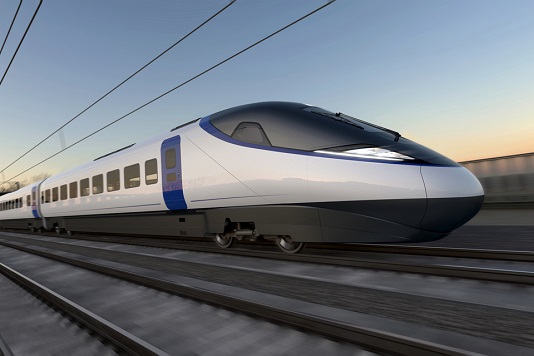
Should HS2 be converted into a road?

Imagine the following nightmare scenario for HS2…

Phase One opens in 2033, around seven years later than originally planned, and tens of billions over budget.

To make matters worse, travel patterns have changed dramatically since High Speed 2 was first conceived. Routine business meetings now take place online, meaning demand for business travel has collapsed.

At the same time, a high proportion of professionals now work from home most of the week. They come into the office only occasionally and often avoid travelling during peak hours. The misery of long-distance rail commuting has largely been consigned to the past – at least for higher income groups.

HS2 still attracts a large number of passengers, though as with HS1, far fewer than forecast when the project was approved. The government has deliberately been slowing down services on the West Coast Main Line (WCML). As predicted, they have rigged the rail market to push more passengers onto the new route.

Competition is still a problem, however. Because few business travellers are using HS2, the vast majority of passengers are day-trippers, tourists, students and so on. They will switch to a slower journey on the WCML, the Chiltern Line, or even the coach if it saves them a few pounds. Inevitably this puts downward pressure on fares.

HS2 therefore faces financial disaster. Its construction was never going to be commercially viable, but it now requires heavy subsidies just to cover its operating costs.

And there are other clouds on the horizon. Driverless cars are finally being rolled out. While their top speed is lower, door-to-door journeys are often quicker than by HS2 – and far more convenient too, particularly for the elderly and those carrying luggage. The demand for rail is being further eroded.

HS2 has therefore become a major headache for ministers. They’ve already wasted tens of billions building the scheme and now it’s going to cost billions more to keep it running. In practice, this will mean cutting services on other parts of the network. After years of economic stagnation, the Treasury can no longer justify vast subsidies for the rail industry.

But there could be a solution.

Converting HS2 into a road has the potential to turn a heavily loss-making white elephant into a profitable business that could cover its operating costs and perhaps help to fill the financial black hole left by the project’s construction.

The government has claimed that up to 18 trains per hour, in each direction, could run along the southern section of HS2. Each train would carry up to 1,100 passengers. This amounts to roughly 20,000 passengers per hour. However, there is widespread scepticism that the planned frequency can be achieved in practice, particularly when many of the services are likely to experience delays on the legacy network before they join the new high-speed line.

Nevertheless, conversion into a road would massively increase potential capacity. Should the market demand it, the route could be managed to eliminate congestion and to maximise passenger numbers. Applying conservative assumptions, 600 coaches an hour, or one every six seconds, could carry 30,000 passengers an hour in each direction with 50 passengers per vehicle. (There are several real-world examples of busways achieving similar results). And obviously there would be relatively simple ways of increasing capacity further, for example by using driverless technology to reduce the gap between vehicles. A two-second gap – frequently observed already on motorways – equates to 1,800 vehicles per hour, or 90,000 passengers – around five times an optimistic figure for HS2.

As for journey times, it’s true that HS2 would reach a far higher top speed than the coaches. However, door-to-door journey times are what counts. The coaches would boast a far higher service frequency. Perhaps one would leave central Birmingham every minute. Better still, they could serve a much wider range of destinations, offering direct services into London and other places on or near the route from a large number of towns, villages and suburbs. Services could use the existing road network before joining and after leaving the former HS2. In this way, a far larger population could benefit directly from the new infrastructure.

Similarly, in London services could go to numerous destinations directly and wouldn’t have to terminate at Euston – perhaps continuing to the West End, City or Victoria Coach Station, for example. This in-built flexibility – which could also open up the route to shorter commuter journeys within the south-east – offers the potential of using the path of HS2 far more intensively than under existing plans.   

The shift in travel patterns detailed above suggests that an ultra-high-capacity route might not be needed. In this case, spare “slots” could be sold to cars and goods vehicles, raising additional revenue and taking pressure off the motorway network. A congestion-free road into central London could prove extremely valuable.

While it has not been possible to cover every aspect of railway conversion in this article (for more details and technical analysis, see the main Transport Watch website), the evidence suggests this option would provide higher capacity at significantly lower cost than HS2 – which would translate into lower fares and eliminate the need for operating subsidies. In addition, there would be major benefits from the greater flexibility to adapt to changing market conditions and new technologies. Finally, there could be significant environmental benefits, with lower top speeds translating into less noise and reduced energy consumption compared with HS2. (Given current policies, it is assumed that the road vehicles using the route would be electric by the mid-2030s).   

Going back to the situation in 2022, the best option remains cancellation of the entire High Speed 2 project. Even though billions have already been spent, the remaining budget would still deliver much higher returns if redeployed elsewhere (see the sunk-cost fallacy). Nevertheless, at some stage over the next few years Phase 1 of HS2 will hit the point of no return – not least due to the political embarrassment from abandoning it as it nears completion.    

When this happens, wouldn’t it make sense for ministers to reconsider the final trajectory of the scheme? Clearly it would be less costly to decide on the road option at a relatively early stage rather than installing a railway, and all its paraphernalia, only to rip it out a few years later.

Richard Wellings

Image: gov.uk

Paul Withrington, R.I.P.

Paul Withrington was one of transport’s visionaries. His ideas promised a transformation in connectivity, with rapid, low-cost journeys right into the heart of the largest cities. The vast subsidies pumped into public transport would be consigned to history. And commuters could all be comfortably seated, ending the ordeal of standing cheek by jowl on railway carriages.

Paul’s key insight was that railway lines were often an inefficient use of transport corridors. Rail routes could typically carry far more passengers and freight if they were concreted over. The nature of their re-purposing would depend on the location and ideally a market discovery process. In the big cities, they might become high-capacity busways during peak hours. Shorter braking distances compared with heavy rail meant that a greater number of passengers could travel along a single track/lane.

A conservative estimate of 600 buses per hour, with 50 seated passengers on each, gives a throughput of 30,000 people – similar to high-capacity subway systems but at far lower cost. And relatively simple new technology could reduce the gaps between vehicles much further, indeed beyond plausible demand levels for any route in the UK. Importantly, Paul explained, the buses would be able to use the existing road network both before and after using the converted track-bed, eliminating much of the inconvenience and delay of having to travel significant distances to and from railway stations.

Several developing countries understood the benefits of achieving Tube-style capacity on the cheap. The busway networks of Bogota, Canton, Curitiba and Istanbul suggested the logic was sound, as did the Lincoln Tunnel’s Express Bus Lane in New York City. And these case studies did not enjoy the full benefits of redeploying rail paths that were fully separated from the existing road network.

In rural areas, smaller towns, and in big cities at off-peak times, buses might make far less sense due to insufficient passenger demand. The converted railways could then be used for conventional road traffic, but with the routes managed and indeed priced, Paul suggested, to prevent congestion. As well as much faster journeys, this promised to take heavy traffic away from overcrowded, stop-start residential roads and urban high streets, bringing major environmental benefits too.

Paul founded the think tank Transport Watch in 1994 in order to conduct, publish and publicise research into these ideas. The organisation expanded on the work of the Railway Conversion League. Drawing on his long career in engineering, transport planning and academia, Paul conducted rigorous statistical analyses on the comparative efficiency of rail and road.

His work attracted the attention of the Institute of Economic Affairs, which published Paul’s articles in the journal Economic Affairs, as well as on the IEA blog. With the support of Lord Vinson, the IEA later created a dedicated transport unit, and in 2015 we co-wrote a comprehensive report based on Paul’s ideas, Paving Over the Tracks: A Better Use of Britain’s Railways? It was a big success in terms of media coverage, with stories in the national newspapers and plenty of TV and radio interest. The editorial column of The Times praised the report for its innovative thinking. But it was ignored by the politicians. The hold of the rail lobby was too strong.

Paul also became a familiar face on the transport conference circuit. Despite his expertise, the organisers did not invite him to give presentations – after all, they depended on sponsorship by the rail industry. But he did get the opportunity to challenge ministers and officials during the Q&A sessions. He managed to bypass the gatekeepers again by publishing full-page adverts setting out the case for railway conversion in magazines such as the New Statesmen, Private Eye and The Week. He also found an outlet through his long and frequent letters to Local Transport Today, a rare example of a transport publication tolerant of open debate.

More recently, Paul focused on opposing High Speed 2, which he memorably described as “a fraud upon the nation”. In his transport planning days, part of his job was giving evidence at public enquiries into major road schemes. This mastery of detail was now deployed to analyse HS2. He contacted officials to try to get to the bottom of the project’s dubious cost-benefit analysis. But in the end, he had to back-engineer the calculations to uncover the assumptions behind them. It turned out that as HS2 costs ballooned, the government had adjusted upwards its forecasts of high-value business travel on the line, thus inflating the benefit-cost ratio. He shared his findings by submitting evidence to parliamentary inquiries, but their technical nature was not conducive to media interest.

Inevitably Paul’s research and campaigning activity attracted the ire of the rail lobby and its army of internet trolls. Rather than engaging with the arguments and debating them, they hurled abuse and tried to smear his character. But Paul shrugged off the nasty attacks with his characteristic good humour.

Transport policy headed in what Paul thought was the wrong direction from the mid-1990s onwards, with massive rail spending central to successive governments’ approach. Paul consoled himself with the knowledge that this policy would eventually collapse under the weight of its own contradictions – not just rail’s high cost base and inflexibility, but also its fundamental impracticality outside big cities and densely populated corridors. Despite ministers’ rhetoric, it was never likely to carry more than a small percentage of passenger and freight traffic, with attempts to expand beyond this facing a cliff of diminishing returns.

The railway’s finances were indeed already in trouble before Covid-19 hit. The big increases in Network Rail debt, which effectively hid the true level of subsidy, had begun to raise major concerns at the Treasury. Paul lived to see the shift to working from home and virtual business meetings – and its disproportionately negative effect on rail travel compared with road.

If these changes are permanent, even for quite a small fraction of the workforce, it could be catastrophic for the rail industry. A combination of high fixed costs and a significant fall in fare revenue could coincide with a government debt crisis in which subsidy increases face strong resistance. If railways become unaffordable, Paul’s ideas may finally get the attention they deserve.

Richard Wellings

This article was originally published on the Institute of Economic Affairs blog.