
How to turn London into Europe’s biggest city

Individuals should be given the freedom to fulfil their potential, rather than being trapped by government policies in towns and cities that hold them back. Having vast numbers of workers in the wrong place weakens the economy by reducing productivity and wealth creation.

In a free society, successful cities and regions can rapidly expand in population, while failing locations can rapidly decline. This process of geographical change is critical for rapid economic growth and big increases in living standards.

Cities in the North of England expanded rapidly during the industrial revolution – and this was vital for their development.

However, the reasons northern cities were centres of wealth creation in the 18th and 19th centuries no longer apply. These days, their economies are largely dependent on government handouts in various forms.

Their predicament is amplified by their location – on the edge of a continent in rapid relative economic decline. High labour, energy and transport costs – and suffocating bureaucracy and red tape – also create a difficult environment for business to prosper.

However, the UK’s geographical disadvantages can be counteracted by exploiting the agglomeration benefits of a very large city. In other words, the “economies of scale” created by a huge conurbation can help to overcome the problems associated with a semi-peripheral location.

Mega cities promote clusters of expertise and innovation. A high degree of specialisation is possible, with a wide range of niche services.  Deep and complex labour markets allow better matching of jobs to skills and talents, which in turn attracts the skilful and talented.

Specialist high-end services combined with high “human capital” attract entrepreneurs and investors from around the world. Providing certain conditions are met – i.e. reasonable tax rates, light-touch regulation and relative political stability – a very large city can create a virtuous economic circle, leading to high levels of productivity and high living standards.  

London should therefore be allowed to grow as large as possible. With state-imposed constraints removed, it could conceivably become the largest city inside Europe.

The administrative area of Greater London currently has a population of around 9 million. The Greater London Built-Up Area, which constitutes the continuous, joined-up conurbation, has around 10 million people. And the wider “London Metropolitan Area” is estimated at approximately 15 million.

In the absence of state-imposed restrictions, these figures (for the sake of illustration) could perhaps grow to 12 million, 15 million and 22 million respectively. However, there should not be fixed population targets or timescales. The outcome should be the result of the voluntary choices made by individuals.  

The main policy change required is liberalisation of the planning system and building regulations. Development should be allowed in London’s green belt. Property owners should also be allowed to “densify” existing neighbourhoods with the minimum of red tape – by building on gardens, adding floors, converting houses into flats, and so on. Under-used land such as parks, playing fields and warehouses could be developed too. A dramatic increase in supply would of course put powerful downward pressure on rents and house prices.

Inadequate transport infrastructure is no longer such a major constraint on the capital’s growth. The shift to working from home (often part-time) means London can accommodate a far bigger population without putting undue pressure on its public transport system (for example by spreading the peaks). And road capacity can quickly be increased by removing various anti-car measures imposed over the last few years (such as barely used cycle and bus lanes etc.).

Furthermore, where appropriate, the capacity of rail corridors could be increased enormously by converting them into busways, which allow higher passenger flows at far lower cost than railways (meaning reduced fares and commercially viable, subsidy-free services).

Water supplies are also frequently cited as a constraint. But a short Severn-Thames link and expanded reservoirs – perhaps combined with desalination plants if absolutely necessary – would resolve this issue.

Of course there should not be state-imposed constraints on the growth of northern cities either. But the chances of say Manchester evolving into a ten-million-plus mega city are slim. London has a first-mover advantage, inertia, a better location closer to Europe’s “core” and already possesses much of the required infrastructure.

Richard Wellings

Image: Wikimedia Commons.
How to avoid paying the London ULEZ charge

A key part of the “climate change” agenda is the policy of driving ordinary people out of their cars and as a result making motoring the preserve of the wealthy and well-connected. One of its most enthusiastic promoters in the UK appears to be Transport for London.

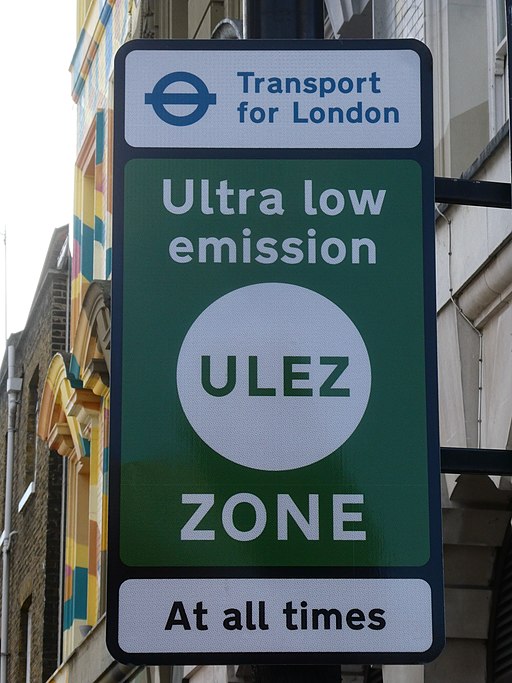
Across the capital, the space available for cars is being reduced, with numerous roads either closed or narrowed, often to make way for bus or cycle lanes that are barely used. Speed limits have also been lowered and the number of traffic controls expanded. Adding to motorists’ misery, a new £12.50 daily charge has been imposed on drivers of older vehicles inside an extended and extensive Ultra-Low Emissions Zone (ULEZ) bounded by the North and South Circular Roads.

The new charge is reprehensible in several ways. Firstly it targets older vehicles which tend to be driven by poorer motorists. In other words it could be perceived as a sly way of trying to force poorer motorists off the roads without stating this openly.

Secondly, it targets diesels in particular, even relatively new ones – this just a few years after motorists were encouraged to buy diesels by the government because they were told they were better for the environment. Diesel drivers have clearly been betrayed after following government advice and now face heavy losses, either through the ULEZ charge, depreciation or the costs of buying a different vehicle.

Finally, the charge is being imposed during a pandemic, a time when elderly and other vulnerable people are avoiding public transport due to the infection risks. This is also a bad time for drivers to be out and about looking for a newer car. Moreover, the policy adds insult to injury for those who need to drive as part of their job and now face a large extra bill at an already extremely difficult time.

It should also be noted that the pretext for the charge – reducing the harm to health from air pollution – doesn’t stand up to close scrutiny. The “evidence” behind this policy is highly questionable, with some commentators describing it as “junk science”. Moreover, the charge itself is unlikely to make much difference to levels of air pollution, yet alone to people’s health. And restricting people’s mobility is likely to be harmful in many ways – fewer outings and less exercise, for example – while the associated economic damage will tend to mean fewer resources are available for healthcare.

Indeed it’s possible that there is a hidden agenda behind this supposed health measure, namely putting in the infrastructure for more general and widespread road-user charging. This would be used to drive even more motorists off the roads, not just owners of older vehicles. It would be naive to expect TfL not to massively expand charging over time, especially given the longer-term anti-car agenda.

In this context, it is imperative that motorists resist this programme and do everything they can to starve TfL of revenue, thus limiting the resources it has available to impose yet more harmful policies.   

Owners of older vehicles who drive frequently and extensively within the ULEZ zone realistically have little choice except to buy another vehicle instead of paying the prohibitive charges. However, for more occasional motorists, there are several strategies that could mitigate the costs and perhaps tip the balance in favour of keeping an older car – particular if much of the mileage takes place outside inner London.

The first method is to cluster trips on a single day, only paying the charge once rather than several times had the trips been spread out over several days. This is not ideal and could take some organising – it will not be possible for everyone – but could be worthwhile financially for those with sufficient flexibility.

Another strategy is to cooperate with nearby friends or family to borrow each other’s cars, providing the drivers are insured and with due regard for infection risks among the vulnerable. So, for example, one friend would use the vehicle in the morning, another in the afternoon, and another in the evening. Using the same car would mean only paying the charge once instead of three times. Alternatively, a driver who owns an older diesel could borrow a friend’s newer petrol vehicle.

For drivers who live relatively near the ULEZ boundary, it may be feasible to park outside the zone and stay out of it for the vast majority of shopping, business and leisure trips.

Finally, Transport for London has been reluctant to disclose the location of its ULEZ enforcement cameras, despite several Freedom of Information requests. The zone covers a large area and coverage is unlikely to be comprehensive. Those of a suspicious nature might think this is the real reason why several London councils closed numerous minor through roads in the months leading up to the ULEZ extension.

Many people will understandably not want to break the law on principle, even if the ULEZ is unethical in many ways. Nevertheless, it seems likely that some shorter journeys may be possible without the charge being imposed – particularly if obvious pinch points like major junctions and main roads entering the zone are avoided.

One possible way to experiment with this is to join the ULEZ Auto Pay system and then keep a record of the routes taken each day, say by marking them on a map. It will soon become clear which journeys are possible without the charge being imposed.

Drivers may feel that there is little they can do to resist the global agenda to reduce their mobility by forcing them out of their cars. However, there are ways to limit the damage and also push back by defunding the organisations hellbent on transforming our way of life without our consent.

Richard Wellings

Image: Wikimedia Commons