Why transport projects keep going wrong

All over the world transport projects “go wrong”, in the private sector as well as in the public sector. It is not just a British problem – though our disasters seem to be worse than most. A common – almost universal – error at the start of most transport projects is unrealistic initial cost estimates.
There are three major generic causes of cost overruns:

  • The high risks of technological innovation. (The “frontiers of knowledge” are also the frontiers of ignorance!)
  • Changes in project specifications and designs (especially from interfering politicians).
  • Evolving safety and environmental demands (which often seem to get absolute priority, whatever their cost).

All three were prominent in the three government transport project disasters in my 2007 book They Meant Well, Government Project Disasters, namely: The R101 Airship; Concorde; and the Channel Tunnel high-speed rail link to London (HS1). 

But Flyvbjerg (with co-authors), who is the leading expert on this topic, has a more brutal view:

“Cost underestimation and overrun cannot be explained by error and seem to be best explained by strategic misrepresentation, namely lying, with a view to getting projects started. … [They] have not decreased over the past seventy years. No learning seems to take place.”

That is a shocking conclusion, suggesting that, despite past evidence, contingency allowances for cost overruns are still usually much too small. Post-project audits should be essential for all major projects, whether they have “gone wrong” or not.

Revenues from transport projects are also subject to huge margins of error, often being wildly over-optimistic. For example, the (private sector) Channel Tunnel had predicted sixteen million Eurostar passengers in its first full year; but the actual number was only three million. (The 1987 forecast for total Channel Tunnel passengers in 2003 was forty million but the actual number was only fifteen million.) Both passenger volume and average level of fares seem to be hard to guess accurately, especially if one ignores potential competition. 

A further danger for government projects is reluctance to abandon projects even after it has become obvious that they are not viable. According to Peter Jay, Concorde’s advocates constantly employed four red herrings: patriotism; the need to keep up with technological progress; unemployment; and the importance of not offending France. (Britain was trying to join the Common Market at the time!) Roy Jenkins, Air Minister in the first Wilson government, tried to cancel this Anglo-French project in 1964, but soon had to un-cancel it!

For government projects, “national prestige” was often a factor. (Speaking about Concorde, Jo Grimond, the Liberal Party leader, said: “Whenever I hear the word ‘prestige’, my heart sinks.”!) My impression is that “national prestige” was rarely a factor in starting a government project; but was likely to come into play once a project had started to go wrong.

In managing transport projects, there are three essentials:

  • Regular reviews, focusing on the latest estimates of the amount and timing of future cash inflows and outflows.
  • Up-to-date market research to try to reassess likely demand where relevant.
  • An “exit champion” if need be, to argue the case for abandonment.

I would even expand the third point and urge the appointment of at least two “devil’s advocates” from the very start of a project (for private sector projects as well as government projects). Their function would be to question everything – and to criticise and oppose where they thought that sensible. The purpose of formally appointing them would be to legitimise their actions. Otherwise, anyone who queries management decisions is likely to be regarded almost as a traitor. (At least two such appointments, because it is much easier to ignore a single person’s views.) Recommending abandonment – which is difficult – would be one of their potential tasks.

Many private sector projects go wrong too; but I suspect they can be quietly dropped sooner and with less fuss than government projects, where political embarrassment is always likely.  (Cancelling HS2 is a partial exception, because probably a majority of the public think that was a sensible decision, merely delayed for far too long.)

In all six of the government projects in They Meant Well, many of the management failures (though by no means all) were really down to politicians: publishing misleading estimates; installing inadequate or over-complex organisations; appointing incompetent managers; insisting on excessive secrecy (a special weakness of British governments!); funking abandonment; or generally interfering in far too many details, which usually leads to extra costs and expensive construction delays.

Before politicians decide to embark on large quasi-commercial projects, they should provide convincing answers to two questions:

  • Why won’t a private enterprise company undertake this project? (If it will, let it.)
  • Why does government, in contrast, think the project worthwhile?

If private sector companies are unwilling to get involved, one obvious reason may be because they think the risks – on either the costs or the revenues (or both) are too high. Political pressures may push governments towards going ahead, even if they are aware of the likely financial outcome (which they may care about less than profit-seeking businesses.)

Flyvbjerg et al. conclude that even with “government projects”, a significant part of the capital required should be genuine risk capital, with private financiers bearing the consequences of a wrong decision to go ahead. That should help ensure a high degree of involvement by private lenders, which in turn should lead to more effective monitoring, better cost control and also better controls against construction delays.

D.R. Myddelton

Image: gov.uk

Why it’s still worth cancelling HS2

Ministers have already wasted an astounding £30 billion on High Speed 2 – but it’s still worth scrapping this ill-conceived vanity project.

The government has fallen victim to the sunk-cost fallacy. It continues to throw good money after bad. The saying “When you’re in a hole, stop digging” is particularly apt.

Cancelling HS2 now would enable the remaining expenditure to be reallocated to higher-value uses, generating far greater returns than continuing to squander vast sums on this loss-making scheme.

Moreover, several billion have gone on purchasing property along the route. Much of this could be recouped – ideally with the victims of the land-grab getting first refusal on their former homes and business, wherever possible.

Scrapping HS2 would also have the benefit of scuppering local vanity projects linked to the scheme – whether loss-making tram links or “regeneration” projects to create state-funded Potemkin villages next to the stations.

On the downside, there would clearly be significant costs from cancelling contracts, laying off staff and so on. But these would be relatively small compared with the ballooning HS2 budget.     

About £27 billion of the total spent so far has gone on Phase One, the section between London and Birmingham (recent government figures have been adjusted to 2023 prices).

The official target cost for Phase One is approximately £49 billion in 2023 prices. Since more than half of this has reportedly already been spent, it’s likely the final bill will be far, far higher.

An independent estimate from a credible source predicted Phase One would end up costing around £67 billion (adjusted to 2023 prices). This looks more plausible than the government’s figures – though the scope of the project has been and remains subject to change, making it problematic to compare like with like.

Much will depend on what happens at Euston. The last 4.5 miles of the line, tunnelled under Inner London, together with the expansion and remodelling of the station, could easily end up costing taxpayers around £10 billion – plus the potential for massive additional costs to improve local transport links to the terminus.    

It’s possible ministers and officials will cook up some way of putting a big chunk of Euston’s costs off-balance-sheet in order to artificially reduce the bloating HS2 budget. But it’s also possible they will abandon this part of the project entirely and terminate trains at Old Oak Common permanently.

Uncertainty about the cost, completion date and scope of Phase One makes it difficult to estimate the costs and benefits. Worse still, there is already a substantial literature questioning the assumptions used to create the various iterations of HS2’s “business case”. For example, the shift to virtual meetings and working from home create a very big question mark over the number of high-value-of-time, high-fare-paying business travellers who will use the new line.

Official figures for HS2 Phase One suggest that the costs are roughly equal to the benefits. The benefits may be slightly higher than the costs if somewhat nebulous “wider economic benefits” are factored in (these are typically relatively small for long-distance routes). However, if realistic assumptions are used for the calculations, the costs are likely to far exceed the benefits (one important aspect of this is discussed below).

It will be interesting to see how escalating costs and other problems affect the government’s next “business case” for HS2 Phase One. Will the figures be manipulated to keep the benefits just above the costs – or will they finally throw in the towel?

Moreover, every pound taken via taxation (or borrowed by the government to be repaid through future taxes) costs the economy significantly more than a pound in total. Taxation and government borrowing impose additional economic damage beyond the direct cost – for example by making certain economic activities no longer worthwhile and incentivising the misallocation of resources. The same is true of printing money to fund schemes – effectively a hidden form of taxation.

In other words, taking these additional costs into account, the benefits of HS2 would have to be substantially higher than the direct costs for the project to be worthwhile (the ratio depends on the nature of the state funding).

In any case, there are plenty of transport schemes that are much better value for money than HS2. The benefits often outweigh the costs by a factor of three, four, five or even more.

Let’s assume, for the sake of argument, that Phase One costs an additional £40 billion from the present to completion (in 2023 prices). If the scheme were cancelled now and that £40 billion invested in much higher value transport projects, it’s plausible it could generate (for illustrative purposes and simplicity’s sake) say £100 billion in benefits. This would far exceed the purported benefits from Phase One (see here for some official estimates and further details of their methodology; note that the “cost” in such calculations is not the same as the project’s budget).

And unlike HS2, such an alternative could provide a strongly positive return even when the wider costs of taxation and/or government borrowing are factored in.

There’s a problem with this solution, however. Politicians and officials often disregard economic analysis when deciding which transport schemes get the go ahead. While HS2 is a particularly egregious example, given its mammoth scale, the rot has also spread to smaller rail projects, road schemes, cycle lanes and so on.

It’s not unusual for projects to get the go-ahead even though the costs outweigh the benefits – and this is based on the official analysis – often “cooked” to make the project look better than it really is in order to please political backers and other vested interests.

So, it’s possible the illustrative £40 billion saved by cancelling HS2 Phase One could end up being wasted on other uneconomic schemes – though it seems unlikely they would be worse than HS2.

Ministers could avoid this outcome by introducing a strict minimum benefit-to-cost ratio for transport projects. If proposals failed to reach this threshold – set quite high to take account of exaggerated benefits, unrealistic cost estimates and other manipulations – they would automatically be refused.

Unfortunately, politicians are typically content forcing taxpayers to fund uneconomic schemes in order to “buy votes” in target regions or curry favour with powerful special interests.

This depressing context makes another option more attractive. As in many Western nations, the UK’s public finances are in deep trouble, with borrowing at dangerously high levels – vulnerable to disaster in the event of a severe external shock. This makes cancelling HS2 to reduce government borrowing a particularly attractive option. It could form the centrepiece of a programme of radical spending cuts, which might also include scrapping other vanity projects.

Restoring confidence in the public finances would have huge economic benefits: encouraging investment, boosting productivity and raising the prospect of future tax cuts. Isn’t this a good reason for ministers to stop digging?   

Richard Wellings

Image: gov.uk

Why the UK needs the Rotodyne and not HS2

The massive investment required by HS2 is wasteful and will provide a very limited set of benefits. This article argues that a better use of funds would be the creation of a compound gyroplane fleet and rooftop landing sites in certain areas of some cities.

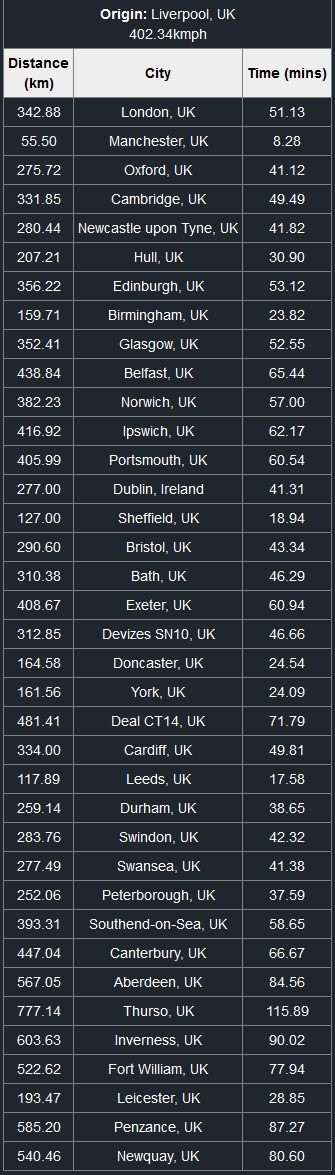
The first point to understand is the physics of high-speed transport. An object moving at twice the speed requires four times the energy. An object moving at four times the speed needs sixteen times the energy.

Thus, a train at 300 km/h is sixteen times more energy greedy than one at 75 km/h, which also should explain to the non-engineers and non-scientist minded why freight trains travel so slowly. High-speed rail is the very opposite of energy efficient. Electric high-speed trains travelling at 300 km/h+ are some of the worst energy guzzling machines we have.

The merit function for high-speed rail puts journey times and city centre to city centre connectivity as high priorities, far above energy efficiency, landscape preservation and flexibility.

For any pairing of cities that does not include London, this project is a bust. Yet the entire country is forced to pay for it.

What worked in Japan was a curious mix of ultra-high population density linked with a small number of population centres on flat plains.

In the UK, with its rolling countryside and older tracks, the 200 km/h tilting Advanced Passenger Train (APT) (although a victim of politics) was the only sensible choice. It exists today as the Pendolino, built under licence from Italian firms within the UK, but mostly abroad.

To create high-speed connectivity for the subset of passengers who require that option every day, the compound gyroplane is a very good choice. This can serve any two points within the UK in a maximum of two hours – not dissimilar to a stratosphere cruising jet, but without the need for expensive airport infrastructure. If the take-off areas are secure, then such a vehicle can even land on rooftops in the City of London.

The compound gyroplane would work for any and every type of person, in every area of the UK, while being a massive export earner and long-term job creation scheme.

The Fairey Rotodyne was an aircraft developed from 1956 to 1962 by the UK aeronautics company Fairey, later merged with Westland. It was a compound gyroplane with propellers and a large main rotor which was operated by “tipjets” – small combustion engines at the extremities of the rotor which provided a jet thrust to move the rotor for take off and landing. The main rotor itself was otherwise unpowered and it would freewheel in flight, providing lift.

This article examines the potential benefits of the craft in terms of providing an addition to the transport options in the United Kingdom. In order to assess these, it is important to engage in some analysis of existing transport modes and their benefits.

The physical geography of the United Kingdom is similar to Japan and New Zealand – a long, thin archipelago. However, the population distribution on the main island, Great Britain, does not lend itself to the construction of high-speed rail in anything but three operational axes which are economically viable. 

The high quality and high speed of the East Coast and West Coast mainlines mean that a good enough quality of travel can be obtained there. Going any faster than 140 mph (225 km/h) is not optimal, due to the energy use and increased cost.

A faster service could be obtained for the comparatively small number of customers who really need to go from London to Newcastle in under 1 hour by using helicopters or small aircraft. At a similar price point to the business class ticket on the high-speed rail system, there is a niche that can be met by use of a hybrid helicopter/aeroplane, which could thus also link the island of Ireland, Isle of Man, Isle of Wight, Scilly Isles, Inner and Outer Hebrides and Faroes. Charter services could perform multi-city stops and hops.

Travel options matrix

The variables we wish to examine are: speed, cost, capacity, energy efficiency and distance.

High-speed rail occupies a specific niche of the transport equation – high speed, high cost, low energy efficiency and medium capacity. The sweet spot for this mode is long distances between 150 and 600 km with large (100+) numbers of passengers.

Low-speed rail is low speed, relatively low cost, highly energy efficient and is almost always high capacity. The distance of this mode of travel is anywhere from 50km to 1000km. From 50+ passengers.

Minibus/coach travel is the lowest cost, highest capacity, low to medium speed, medium energy efficiency and very flexible. The distance of this mode of travel is anywhere from 50km to 1000km. 20+ people. Linking islands is only possible with the use of ferries.

Car travel is medium cost, medium speed, low capacity, low energy efficiency and the most flexible of all the ground transport options. The distance of this mode of travel is anywhere from 3km to 1000km. Linking islands is only possible with the use of ferries

Aeroplanes are the highest speed, high cost, inflexible and need long distances for the cost-benefit analysis to make sense. They are only efficient (in both terms of cost and energy) with very large numbers of people and somewhat medium to very long distances. Apart from flights from the South of England to Scotland, Ireland or the North of England, this is not a viable option for intra-UK travel.

Helicopters are the highest cost, most flexible form of transport in the UK, though of very low capacity and abysmal energy efficiency. More versatile in terms of places that can be reached and at speeds comparable with high-speed rail, they are nevertheless almost prohibitively expensive for anything but occasional use. They are not a commuting option.

Within this matrix, there exists an unmet niche: that of high speed, medium to high capacity, low to medium cost, with flexibility comparable to helicopters.

Enter the Rotodyne compound gyroplane.

Eric Matthew W. Masaba

Image: Rotodyne 2 by L. Chatfield, Flickr (CC by 2.0), cropped.