The massive investment required by HS2 is wasteful and will provide a very limited set of benefits. This article argues that a better use of funds would be the creation of a compound gyroplane fleet and rooftop landing sites in certain areas of some cities.
The first point to understand is the physics of high-speed transport. An object moving at twice the speed requires four times the energy. An object moving at four times the speed needs sixteen times the energy.
Thus, a train at 300 km/h is sixteen times more energy greedy than one at 75 km/h, which also should explain to the non-engineers and non-scientist minded why freight trains travel so slowly. High-speed rail is the very opposite of energy efficient. Electric high-speed trains travelling at 300 km/h+ are some of the worst energy guzzling machines we have.
The merit function for high-speed rail puts journey times and city centre to city centre connectivity as high priorities, far above energy efficiency, landscape preservation and flexibility.
For any pairing of cities that does not include London, this project is a bust. Yet the entire country is forced to pay for it.
What worked in Japan was a curious mix of ultra-high population density linked with a small number of population centres on flat plains.
In the UK, with its rolling countryside and older tracks, the 200 km/h tilting Advanced Passenger Train (APT) (although a victim of politics) was the only sensible choice. It exists today as the Pendolino, built under licence from Italian firms within the UK, but mostly abroad.
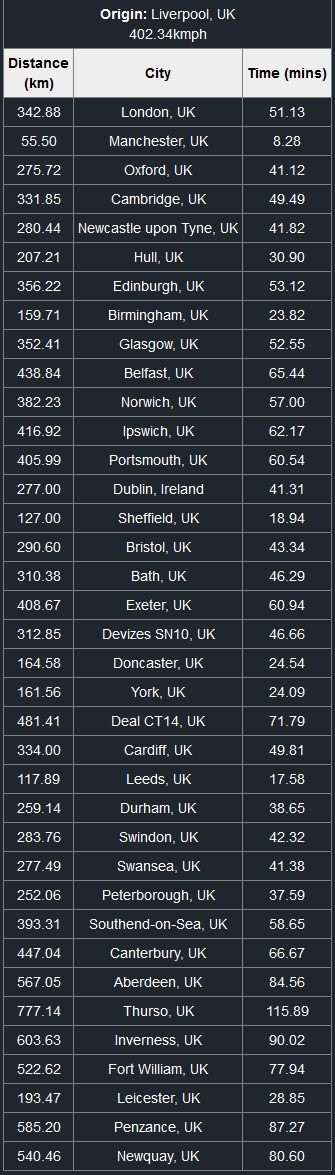
To create high-speed connectivity for the subset of passengers who require that option every day, the compound gyroplane is a very good choice. This can serve any two points within the UK in a maximum of two hours – not dissimilar to a stratosphere cruising jet, but without the need for expensive airport infrastructure. If the take-off areas are secure, then such a vehicle can even land on rooftops in the City of London.
The compound gyroplane would work for any and every type of person, in every area of the UK, while being a massive export earner and long-term job creation scheme.
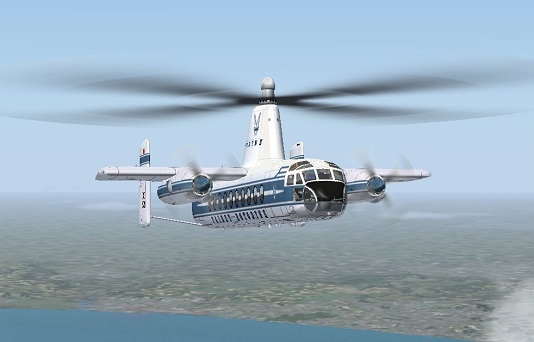
The Fairey Rotodyne was an aircraft developed from 1956 to 1962 by the UK aeronautics company Fairey, later merged with Westland. It was a compound gyroplane with propellers and a large main rotor which was operated by “tipjets” – small combustion engines at the extremities of the rotor which provided a jet thrust to move the rotor for take off and landing. The main rotor itself was otherwise unpowered and it would freewheel in flight, providing lift.
This article examines the potential benefits of the craft in terms of providing an addition to the transport options in the United Kingdom. In order to assess these, it is important to engage in some analysis of existing transport modes and their benefits.
The physical geography of the United Kingdom is similar to Japan and New Zealand – a long, thin archipelago. However, the population distribution on the main island, Great Britain, does not lend itself to the construction of high-speed rail in anything but three operational axes which are economically viable.
The high quality and high speed of the East Coast and West Coast mainlines mean that a good enough quality of travel can be obtained there. Going any faster than 140 mph (225 km/h) is not optimal, due to the energy use and increased cost.
A faster service could be obtained for the comparatively small number of customers who really need to go from London to Newcastle in under 1 hour by using helicopters or small aircraft. At a similar price point to the business class ticket on the high-speed rail system, there is a niche that can be met by use of a hybrid helicopter/aeroplane, which could thus also link the island of Ireland, Isle of Man, Isle of Wight, Scilly Isles, Inner and Outer Hebrides and Faroes. Charter services could perform multi-city stops and hops.
Travel options matrix
The variables we wish to examine are: speed, cost, capacity, energy efficiency and distance.
High-speed rail occupies a specific niche of the transport equation – high speed, high cost, low energy efficiency and medium capacity. The sweet spot for this mode is long distances between 150 and 600 km with large (100+) numbers of passengers.
Low-speed rail is low speed, relatively low cost, highly energy efficient and is almost always high capacity. The distance of this mode of travel is anywhere from 50km to 1000km. From 50+ passengers.
Minibus/coach travel is the lowest cost, highest capacity, low to medium speed, medium energy efficiency and very flexible. The distance of this mode of travel is anywhere from 50km to 1000km. 20+ people. Linking islands is only possible with the use of ferries.
Car travel is medium cost, medium speed, low capacity, low energy efficiency and the most flexible of all the ground transport options. The distance of this mode of travel is anywhere from 3km to 1000km. Linking islands is only possible with the use of ferries
Aeroplanes are the highest speed, high cost, inflexible and need long distances for the cost-benefit analysis to make sense. They are only efficient (in both terms of cost and energy) with very large numbers of people and somewhat medium to very long distances. Apart from flights from the South of England to Scotland, Ireland or the North of England, this is not a viable option for intra-UK travel.
Helicopters are the highest cost, most flexible form of transport in the UK, though of very low capacity and abysmal energy efficiency. More versatile in terms of places that can be reached and at speeds comparable with high-speed rail, they are nevertheless almost prohibitively expensive for anything but occasional use. They are not a commuting option.
Within this matrix, there exists an unmet niche: that of high speed, medium to high capacity, low to medium cost, with flexibility comparable to helicopters.
Enter the Rotodyne compound gyroplane.
Eric Matthew W. Masaba
Image: Rotodyne 2 by L. Chatfield, Flickr (CC by 2.0), cropped.

 Transport Watch