Climate change policies and economic collapse

Climate change is providing a pretext for all manner of restrictions on our lives. As a consequence, climate change policies are now one of the biggest threats to individual freedom.
There is good reason to believe this is at least partly deliberate, that the climate change agenda is a Trojan horse for more sinister ends: socialist-style central planning of the economy, dictatorial global government, and grabbing a greater share of assets and resources for transnational “elites.”

This context explains why the flaws of the official climate change narrative are rarely debated. They are largely ignored by tightly controlled media outlets and the seemingly bought-and-paid-for scientific establishment.

The standard narrative says climate change is a major threat to civilisation. A “scientific consensus” suggests it will lead to “extreme weather” – stronger hurricanes, worse flooding, droughts and forest fires.

This will destablise society, it is claimed. Parts of the world will no longer be able to support agriculture. Food and water shortages will worsen, leading to migration on an epic scale. Even relatively resilient countries face huge costs to strengthen flood defences, adapt essential infrastructure and so on.

An obvious flaw is how this perspective neglects or ignores potential benefits from climate change. Global warming could reduce heating bills and winter deaths in cold countries. Raised CO2 levels tend to increase crop yields. Higher rainfall could be helpful in many locations.

It is not obvious that the costs of any climate change will outweigh the benefits, or if they do, by how much. In any case, it is disingenuous to argue these costs and benefits can be properly quantified. They are highly subjective at the individual level and therefore hard to measure, monetise and aggregate. This is highly problematic when trying to set policy in a rational way or determine optimal temperature targets.

Scientific modelling provides a crutch for the policy activists. But the record of both climate and economic modelling is appalling – including over the short run.

And even if short-term success were achieved, this would not guarantee long-term accuracy. There are numerous factors that modellers cannot know, such as the impact of unpredictable natural events or sudden advances in technology – or indeed individuals’ preferences decades in the future.

Climate change activists perhaps have a more compelling argument when they argue that this lack of knowledge is a major reason why humanity should be worried. If the models were reliable, then people would have a good idea what’s in store and could take steps to address the problems. But the inherent uncertainties mean catastrophe is possible.

The chances might be slight, but climate change could wipe out much of humanity, perhaps because unknown positive feedbacks occur or certain tipping points are breached. From this perspective, the lack of knowledge provides a rationale for caution.

Norman et al. write:

“Without any precise models, we can still reason that polluting or altering our environment significantly could put us in uncharted territory, with no statistical track record and potentially large consequences.” …

“It is the degree of opacity and uncertainty in a system, as well as asymmetry in effect, rather than specific model predictions, that should drive the precautionary measures. Push a complex system too far and it will not come back. The popular belief that uncertainty undermines the case for taking seriously the ‘climate crisis’ that scientists tell us we face is the opposite of the truth.”

However, while the nature of the uncertainty and opacity are not the same, there is also a lack of knowledge about the impact of policies designed to tackle climate change.

To paraphrase the above quotation, without any precise models, we can still reason that altering our economy significantly could put us in uncharted territory, with no statistical track record and potentially large consequences.

Climate change policies are already undermining productivity growth in many countries. The process by which living standards increase due to big reductions in energy and transport costs has been choked off.

Climate change is also providing a pretext for trade barriers, with industries in Europe resenting “unfair” competition from countries with looser environmental standards.

Then there’s the increasing state control of the economy, with major sectors centrally planned by government bureaucrats. Think of the forced shift to renewable energy and electric cars, or state meddling in agriculture.

All this promotes economic stagnation or decline. In turn, it could create a vicious circle, with interest groups lobbying more intensively for government favours as the size of the pie shrinks – a negative sum game compounding the damage.

Look how heavy industry in Western Europe, crippled by high energy prices, has been propped up by state subsidies to keep it alive, or how growing fuel poverty is putting pressure on the welfare state.

It’s possible to envisage climate change policies pushing the political culture in a far more socialist direction in reaction to social and economic problems caused by the radical green agenda (difficulties which will, however, be blamed on convenient scapegoats, such as an imaginary “free market”).

Climate change policies could therefore be a monumental disaster for the economy and society, threatening key drivers of wealth creation such as trade, economies of scale, and specialisation.

This would bring big declines in living standards, perhaps even disasters similar to those predicted by climate change alarmists, such as large-scale starvation and population displacement.

While it could be argued that economics is less uncertain than climate change, the outcome might also depend on highly unpredictable combinations of economic decline, reduced resilience and “external shocks” such as war, natural disasters or pandemics.

It is also conceivable that ill-conceived climate change policies could end up reducing resilience to climate change itself (natural and/or human-influenced), with catastrophic outcomes resulting from a combination of both. The uncertainty could thus be compounded.

The policy implications are clear. Climate change measures that create major economic uncertainty by damaging fundamentals such as individual freedom, property rights, wealth creation, productivity growth (and thus food availability) should be discarded. The focus instead should be on win-win policies that benefit both the economy and the environment. These are measures that should be implemented whether or not climate change is viewed as a serious threat.

This means phasing out the vast and inefficient state subsidies to activities that emit “greenhouse gases,” such as non-viable agricultural practices, elements of the fossil-fuel industry, loss-making parts of energy and transport networks, and much of the military.

Government theft of land, often on behalf of crony-capitalist corporations, should also cease. Property rights should be respected, including those of various indigenous peoples whose form of ownership might differ from current European norms.

State control over vast swathes of the planet is illegitimate. It took place through violent conquest without the consent of the original inhabitants. A policy of non-interference, combined with returning these areas to their rightful owners and ending state subsidies, would prevent much of the damage to ecosystems that bolster the resilience of the planet. Economy-killing climate policies would then be even less defensible.

Richard Wellings

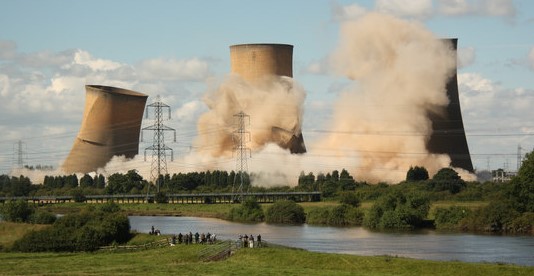
Image: Croft, R., Wikimedia Commons, CC2.0.
Donate

Political manipulation and the push for climate lockdowns

The plan is clear. The political elite want to create what amounts to a new feudal system, with the manipulation of the green agenda providing a convenient pretext.

Ordinary people’s mobility will be severely restricted. They will be forced out of their cars and off the roads by a raft of new charges and controls. Their lives will largely be confined to “15-minute cities.”

But the perpetrators have a problem. These measures are deeply unpopular with a large percentage of the public. And they are being imposed in ostensible democracies. So, they need a strategy to overcome resistance.

One element is a relentless propaganda campaign to promote the idea of a “climate emergency.” With clear parallels to the manipulation strategies deployed during the pandemic, they’re trying to persuade the public that a form of lockdown is necessary to stop global warming.

This is why the BBC lectures viewers on climate change every time there’s a heat wave, flooding or forest fires. It’s also why the BBC has effectively banned proper debate on environmental issues, with sceptical voices not welcome on its outlets. The understandable anguish created by images of natural disasters is used to undermine free speech on the issue.

The second element is a focus on local government. There’s a reason why mayors and councils are taking a leading role in the “climate lockdowns” policy, while central government pretends to be more motorist friendly. The establishment is exploiting the different incentives facing members of the public.

The benefits of measures such as “low-traffic neighbourhoods” (LTNs) are highly concentrated and obvious to the relatively small number of beneficiaries. By contrast, the costs, which may be enormous by comparison, are typically dispersed and not always obvious to the losers.

If a through road is closed off by the council, many of its residents will support the new restriction (though some may be against – for example if it means much longer journeys). Their street may be quieter and perhaps safer. This constituency offers a bedrock of support for such measures.

It will be bolstered by locals ideologically wedded to the green agenda, perhaps the result of a lifetime of indoctrination by schools, universities and the media, with no exposure to the counter arguments.

They will be joined by state-funded “sock puppets” – campaign groups paid by government to lobby itself and create a fake impression of wider support for policies that the political elite have already decided to impose.

By focusing on the local level, the instigators can build a sufficient coalition of supporters to at least make the argument that they’re not imposing their agenda despite overwhelming public opposition.

Indeed, many of the losers from such policies will not even live or vote in the borough or city where the new controls are being installed. They may be commuters or businesses now facing prohibitive charges or massive delays to their journeys.

Residents in areas beyond the schemes may see a big increase in congestion as traffic is displaced. The emergency services might become less efficient as they can no longer take a direct route, or because cycle lanes mean motorists can no longer get out of their way to let them pass. Labour mobility, productivity and wages may decline because potential employees can’t reach jobs that match their skills, and economies of scale may be lost as the populations that can be profitably or efficiently served shrink (click here for a more detailed discussion).

It will not always be obvious to people that the “war on motorists” is to blame for these negative economic impacts, which in turn dilutes political resistance to the new restrictions. And these effects are spread over a much wider geographical area than the benefits (that accrue to a small, concentrated group), which means opposition is harder to coordinate.  

Note that the purported non-local environmental gains are quite tenuous. The costs and benefits of any future climate change are impossible to calculate accurately. And the impact of the new controls will be negligible in terms of global emissions. In any case, anti-car policies are often counterproductive. Artificially created congestion can actually increase pollution.

Rather than restricting ordinary people’s mobility – and effectively creating a new feudal system in the process – policymakers should focus on win-win policies that both cut emissions and benefit the economy. This means ending the vast subsidies pumped into various polluting activities.

It speaks volumes that governments are so reluctant to take this obvious step. The green agenda is really about giving even more power to the elite and their institutions rather than saving the planet.  

Richard Wellings

HS2 and the “Great Reset”

High Speed 2 never made any economic sense. In commercial terms it was always going to make heavy losses. Ballooning budgets mean the costs are now likely to outweigh the benefits. And it’s crystal clear that alternative transport investments would deliver far higher returns.

So, why on earth is the project still going ahead?

One theory is that transport policy was captured by powerful special interests. Construction firms, train manufacturers and an army of consultants stand to cash-in from the scheme. They certainly haven’t been shy about lobbying MPs and ministers over the last few years.

Councils in the North and Midlands will use HS2 to grab yet more taxpayers’ cash to fund their pet “regeneration” projects around the new stations. No wonder they’re backing the line so strongly.

Then there are the senior bureaucrats. HS2 provides them with some of the best-paid jobs in government.

But there are compelling arguments against the special interests hypothesis. This is not to deny their influence on policy, but to question whether it is strong enough to be decisive.

Looking at political incentives, HS2 has been unpopular with the public, those against typically far outnumbering those in favour. The scheme has also been an endless source of embarrassment and bad publicity for successive governments, with numerous negative media stories on cost overruns, deception, incompetence, protests and the ill treatment of businesses and residents along the route.   

Having said this, the current government’s levelling-up agenda undoubtedly plays into the hands of the HS2 lobby. They could now argue that ministers were abandoning their pledges to boost the North should the line be cancelled or scaled back.

But earlier on, it would surely have made political sense to scrap HS2 and instead lavish the money on regeneration schemes in individual towns and cities across the region, including local transport upgrades. This would have been a quicker, more effective and less risky way of “buying” votes.

So, neither special interests nor political incentives seem to fully explain why HS2 is going ahead – which brings us to another possibility.

During the pandemic, awareness has grown about the so-called Great Reset agenda, often marketed by politicians as “Build Back Better”. This set of policies, promoted by transnational “elite” institutions such as the World Economic Forum and the European Commission, is being imposed across the Western bloc and its satellites.

At the heart of this shift is radical environmentalism – at least when taken at face value. In transport policy it translates into a ruthless war on drivers. This assault was ramped up in 2020 with the government paying councils to close large numbers of roads to through traffic and narrow main roads to install (often empty) cycle lanes.

Ministers also announced a ban on the sale of new petrol and diesel cars from 2030. The cost of electrification is likely to run into the high hundreds of billions, with motorists picking up much of the bill. The government is also considering introducing a national road pricing scheme, ostensibly to replace the vast revenues currently stolen from motorists via fuel duty.

It isn’t difficult to discern the direction of travel. Ordinary motorists will gradually be forced off the roads by a combination of regulation, tolls, taxes and closures. Driving (and also flying) will increasingly be the preserve of the rich.

So, how does this agenda relate to HS2?

At the moment a significant proportion of people travelling from the South East to the North or Midlands, or vice versa, choose to drive. Rail makes most sense for city centre to city centre journeys, particularly trips involving central London, which is car unfriendly to say the least. But if the journey starts and finishes in the suburbs, if other stops are planned en route, or if heavy luggage is carried, the car is often quicker and more convenient than the train.

However, if the Great Reset agenda is enforced, most people won’t have this choice in fifteen or twenty years’ time.

Imagine someone driving from Yorkshire to London in the not-so-distant future. He struggled to afford an expensive electric car and rapid charging socket, and is saving up for the eventual battery replacement.

He incurs heavy tolls as the government tracks his drive south. On entering London, the surveillance system levies an additional hefty “congestion charge” tax. He’s then delayed by 20 mph speed limits, cycle lanes, road humps and chicanes. The route he used to take is no longer possible due to road closures and he has to make a long detour.

On arriving at his destination he struggles to find a parking space. One side of the road has been turned into a cycle lane and the other is permits only. When he finally finds one, the charge is prohibitive. He decides that he won’t bother driving next time. He will use video conferencing or if absolutely necessary take the train.

So, the transport market is going to be so heavily rigged that most people will have little choice but to travel by rail if they make these kind of journeys – assuming they can afford it (these policies are likely to bring a major reduction in overall personal mobility, with negative knock-on effects on job opportunities, business costs, productivity and wages).

This authoritarian agenda may explain politicians’ attachment to HS2. Senior officials and ministers have been aware of and signed up to Great Reset-type policies for years. They knew a big crackdown on private motoring was coming and were just waiting for a pretext to impose it. In the meantime, the true scale of the shift and its implications would deliberately be hidden from the public.

HS2 will prove very useful to government ministers during the coming assault on private transport and mobility. They will deploy it to deceive the public that they are speeding up journeys and improving connectivity when for the vast majority of travellers the exact opposite is true.

It is no coincidence that the EU, together with the UK and US governments, are all now promoting uneconomic high-speed rail and very similar transport policies more generally. This is a top-down agenda, ordered by an unaccountable transnational “elite” and imposed by its lackeys in national governments. Both liberty and democracy are being crushed in the process.

Opposing this railway is therefore about far more than saving taxpayers’ money, protecting private property and halting environmental destruction. If HS2 is stopped, or even scaled back, our leaders will find it harder to undermine people’s freedom to travel.

Richard Wellings