
This post provides the abstract to Part 2 of our paper Better User of Railways, the first of which formed the background to the IEA publication “Paving over the Tracks” February 2015. Parts 1 and 2 are both here .
The height of Government fantasy is represented by the Greenwash diagrams taken from Cm 7996: Creating Growth, Cutting Carbon – Making Sustainable Local Transport Happen Jamuary 2014. The diagrams are at pages 23 and 24 within the Website copy of the full Part 2.
“Abstract and a question.
This note provides snapshots from the dawn of the railway age to the present (2013), touching the week of terror, 1847, Black Friday, 1866, railway closures since the Great War, early ring roads for London, the ever rising losses on the railways, the endless presumption that profit was just round the corner, contrary views, (Brigadier’ Lloyd’s seminal paper of 1955, Stewart Joy’s book, “The train that ran away”, the Hall smith report of 1976, “Better use of Rail Ways”), Beeching, Serpell, the endless white papers, the Prescott plans (better for everyone) perhaps a thousand bullet points; all against the background of the rail’s share falling to 1.7% of passenger journeys before rising to today’s trivial 3%, representing a slightly less trivial 8.7% of passenger-miles, along with 8.5% of tonne-miles.
• Endless policy statements in defiance of the numbers – declaring for ever and a day that rail is essential to the nation, that congestion can be solved by investing in pubic transport (a mode carrying only 12% of passenger miles), despite the obvious impossibility of buses, let alone trains serving the dispersed land-use enabled by the car.
• Unreality reaches new levels with cartoons illustrating how, in 2011, Whitehall envisaged the future. “Anytown” and “Anyvillage” are magic places from which the car has vanished in favour of the bus, cycle lanes, railway stations, travel plans tempting us to walk and bicycle sheds, let alone the green paint.
• High speed rail in defiance of Sir Rod Eddington’s careful analysis – as always, a wilful disregard for the numbers
We make no apology for repetition since the history is one and the same; an endless sequence of doing the same as yesterday while expecting a different result.
We do not analyse the reasons believing them to be self-evident and institutional, namely vested interests on a grand scale coupled with subsidy, running to hundreds of billions of pounds. That has perpetuated a system which would, under market forces, vanish overnight, see Part 1.
But first we ask a question. Is it all an historical accident?
Had the technology of tar and bitumen Macadam, road building and the pneumatic tyre existed in 1825, the dawn of the railway age, would the railways ever have existed? As it was it seemed obvious that the only way to drag large loads was on steel or iron tracks secured by cross pieces and to the ground below. However there were penalties. For reasonable speed, the track had to be laid to a very high tolerance and maintained at that tolerance. The stopping distances, and hence headways for the very heavy vehicles had to be large. (Today the distances used in design are about four times as great as required for roads). The vehicles lacked manoeuvrability; a broken down train could not be simply pushed to one side as can a road vehicle, and is much more difficult to rescue due to access problems. No other vehicles could use the track and the trains could not leave it.
Once these superb rights of way were paved with railway lines it became impossible, or at least impossible in imagination, to remove the steel in favour of the far more efficient and less costly road surface. Reason was blighted by the seeming order, imagined efficiency and the beauty of a pair of railway tracks curving away in the distance, gleaming in the morning sun, even though the pair would generally be empty of trains. It was as though, having gone down one evolutionary path, it was impossibly for the beast to evolve as it might otherwise have.
In reality that inflexibility grew out of vested interest and because of the dead hand of Government subsidy. The railway lobby had enormous influence in Parliament. Consequently the decades which followed were, as noted above, a catalogue of doing today what was done yesterday, in defiance of the numbers, and expecting a different result.
If instead there had been a fiat to the effect that land already committed to transport should be retained in that use for the good of the community as a whole, whilst denying subsidy, the market and financial realism would have driven the network owners to make the only sensible decision. That would be to pave the railways. The rights of way would then have been immensely profitable, as are the roads where tax-take far exceeds expenditure. Furthermore all those crushed London surface rail commuters would have seats at fraction of the rail fares they now suffer.
The value of the opportunity lost is beyond calculation, a dreadful indictment of Government interference in the market. Remember, even in the peak hour, in highway terms London’s vast, often grade-separated rail network, is substantially disused, see Part 1 and Topic 15.

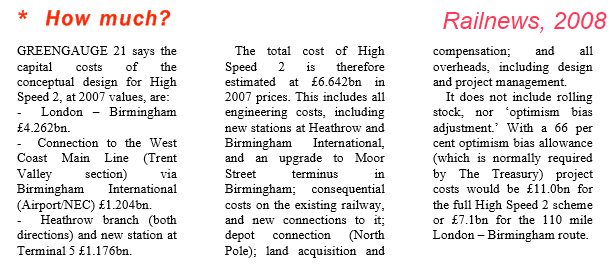 2008 Greengauge 21 estimate for a London – Birmingham high speed line
 Transport Watch