COMEAP’s particulates advice deserves to be questioned

This letter was originally published in issue 811 of Local Transport Today.

Alan Wenban-Smith’s categorisation of my exposure of the flimsy and contradictory nature of the Committee on the Medical Effects of Air Pollution’s analyses on particulates, as that of a “conspiracy theorist”, is inappropriate.

It was the committee not me, that pointed out the extraordinarily wide 75 per cent plausibility limits (one-sixth to double the values cited) and the committee, not me, that published Professor Hopke’s view that policy decisions should not be based on the (in my view disgraceful) use of the process of elicitation as used by the committee.

Where COMEAP went wrong was to press on with providing a quantified estimate of deaths linked to particulates, instead of telling the government that after years of work it could not establish a relationship between deaths and particulates with enough confidence to justify policy. Readers may care to make their own mind up about that in the light of the following:

1. The COMEAP reports generally refer to all anthropogenic particulates, not just to those from road traffic.

2. The COMEAP report of 2010 says anthropogenic particulates caused 29,000 premature deaths in the base year 2008 but with limits ranging from one-sixth to double that number. The report also says eliminating these (anthropogenic) particulates would save between 5.8 million and 66.2 million life years over 106 years, a vast range.

3. In 2014 I asked COMEAP for the mortality burden savings attributable to particulates from road traffic. Dr Sarah Robertson replied: “A number of sources, of which traffic emissions is only one, contribute to PM2.5 background concentrations in urban areas across the UK. Based on the modelled figures underpinning the COMEAP 2010 report, PM2.5 from local traffic sources contributes to approximately 16 days of the approximate 200 days loss of life expectancy in the UK attributable to anthropogenic PM2.5 in 2008. However, this does not represent the total contribution of traffic emissions to PM2.5 concentrations at UK urban background sites. Traffic is also a contributing source of regional primary and secondary PM2.5 concentrations. Detailed figures for traffic contributions to these aspects in 2008 are not available. However, extrapolating from modelled data for 2012 suggests that regional primary PM2.5 concentrations from traffic emissions equates to an additional seven days loss of life expectancy in the UK.” So, particulates from local and regional traffic contribute just 23 (in a range of four to 44 days), or ten per cent to the overall mortality burden of 200 days.

4. Particulates from exhausts are now a minor component of all particulates from traffic, which itself is a minor contributor to all anthropogenic particulates.

5. The LTT report of 2 October says COMEAP can find no “compelling narrative of adverse health effects from non-exhaust particulates from road traffic”.

Against that background, is it not reasonable to ask why COMEAP did not draw the same conclusion as at point 5 above with regards to particulates from exhausts? Namely, although it is reasonable to assume particulates are not good for us there is no compelling narrative linking particulates to premature deaths.

Of course, COMEAP was caught between a rock and a hard place. It may have sabotaged its very existence or been politically unacceptable for it to present such a conclusion. Heaven knows how much these studies have cost, but the cost to the nation of a policy that scarcely has any basis is vast.

As to Alan’s point about nitrogen oxides being the main concern associated with diesel, COMEAP concluded in 2018 that the effects of NOx could not be separated out from those of particulates. There is a very good summary of that by Air Quality News (https://tinyurl.com/y6x8sg3r). It cites COMEAP as finding, “The methodology of this present report allows for calculations to be made on the basis of either particulate matter known as PM2.5 or NO2, and using the higher of the two estimates. The results should not be added together as this would lead to an over-estimation of the effects. Using these two approaches, the range of estimates of the annual mortality burden of human-made air pollution in the UK is estimated as an effect equivalent to 28,000 to 36,000 deaths.”

Lastly, no one seems to have tackled the environmental damage that electric cars will do – all that lithium and those rare earth metals mined from sea beds and the difficulty of recycling 30 million toxic electric car batteries.

Meanwhile, Extinction Rebellion and a certain Swedish school girl caught the world’s attention by saying the world would burn in ten yours unless something is done. Bah, it’s been far warmer in the past and the world did not catch fire.

Strangely, I am a ‘green’ but I believe the greens have the wrong focus, possibly driven by a hatred of cars. In order of magnitude, the threat to the environment and human survival are: demographics, wars, plastics and effluent of all sorts tipped into the sea, pesticides, and habitat destruction.

Paul Withrington, Director, Transport-Watch

The war on road traffic particulates is based on junk science

Forgive me for following up my letter. I do so because, in the same issue, we have (a) two experts disagreeing almost violently as to the efficacy of battery electric vehicles (“The route to zero emissions, or over-hyped”) and (b) under the headline, “No compelling evidence that brake and tyre dust harm health”, we have COMEAP declaring that there is “no compelling narrative of adverse health effect of exposure to non-exhaust particles from road traffic”.

Recapping, my previous letter: the “Great dirty diesel scare” was sparked by the COMEAP report of 2010. It claimed particulates were causing “29,000 premature deaths”. The same report says that the 75% plausibility limits range from one sixth to double the cited numbers. I pointed out that the finding was akin to a scientist stating that the average height of a man was six feet but with a plausibility range of one foot to 12 feet. Worse still the numbers depended on the disgraceful procedure of elicitation – asking experts, with no data, for their views as though there can be any “experts” with no data.

I go on to point out that the COMEAP report, “UK Plan for tackling roadside nitrogen dioxide concentrations”, of July 2017 has, under the heading “Estimating the mortality burden attributable to current concentrations of air pollutants”, the following admission: “Some Members do not think it appropriate to try to calculate an overall burden of the mortality associated with the air pollution mixture”. They were right, but overruled. 

In any event, the 2010 report contains a figure showing that particulates from local traffic are a minor contributor to the overall particulate burden. Worse still Engineering and Technology, March 2017 and the Air Quality Expert Group’s report, “Non-exhaust emissions from road traffic”, dated 2019 find that by as early as 2022 hardly any of the particulates from road traffic will be from exhausts! By that date it is unlikely that the battery electric vehicle will have made significant penetration. Hence the data represent a largely internal combustion engine powered fleet.

So, given the very wide plausibility limits cited by COMEAP, the technical disagreements, and the vanishingly small proportion of particulates which are from exhausts, the honest conclusion should be that there is insufficient evidence to justify any policy designed to reduce these, or any other particulates

We now have the amazing statement by COMEAP reported above, namely, “There is no evidence that non-exhaust particulates cause harm”. How on earth would they determine which particulates harmed health, I ask? I go on, if these non-exhaust particulates do not damage heath, and if particulates from exhausts are a vanishingly small proportion of the whole and if their impact on heath is entirely uncertain, why on earth are they destroying the diesel industry?

I conclude that COMEAP makes its claims in the knowledge that they play well with the often data free, anti-car and green lobbies which have such strong but misguided influence on policy.

Paul Withrington

A version of this letter was published in Local Transport Today on 16 October 2020.

The great dirty diesel scare and other nonsense

Letter published in Local Transport Today, Issue 808, 2 Oct 2020.

The great dirty diesel scare was sparked by the COMEAP report of 2010 which claimed particulates were causing “29,000 premature deaths” with an average loss of life of six months across the nation. The same report says that the 75% plausibility limits range from one sixth to double the cited numbers.

Well, if a “scientist” estimated the average height of a man as six feet but with  plausibility limits ranging from one foot to 12 feet, would we take any notice of him? So, why does anyone take notice of the COMEAP finding – especially when the statements depend, in part or whole, on the disgraceful process of elicitation, namely asking “experts” for their best guesses, presumably in the absence of data? Indeed Professor P. K. Hopke in an appendix to that report says, “I find the elicitation of experts to be an approach that involves too much subjectivity and is likely to be unreliable. I would suggest one be very careful using the guesses of experts as the basis of policy decisions.”

Worse still only about 50% of particulates come from exhausts with the rest from road, tyre and brake wear. These other items could be magnified by electric cars because of their greater weight.

Meanwhile we have Professor Michael Kelly and Gautam Kalghatgi pointing out the folly of the electric car in your columns.

Despite all that, the report has led to the virtual demise of the diesel industry.

Paul Withrington

Journalists lose the plot

Letter to Ben Webster, Environment Editor, and Graeme Paton, Transport Correspondent, at the Times, copied to the Secretary of State for Transport and the Minister:

Dear Ben and Graeme,

On 28th January Ben had a column with the laughable headline, “Track-side wind farms could power HS2 trains”, and on Thursday Graeme had an equally laughable one, “Solar trains timetabled to replace diesels”.

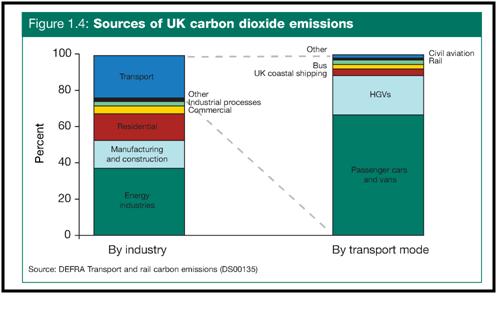
Laughable or not, the diagram below, from Cm 7176: Delivering a Sustainable Railway, July 2007. illustrates that, even if the entire railway could be run that way and even if the emission was then an impossible zero, the effect on the nation’s emissions would be vanishingly small.

Those columns of yours, and the nonsense about hydrogen power, do nothing but promote the quite false impression that the railways are uniquely green when nothing could be further from the truth.

Why do you waste your time on such trivia and to such damaging effect?carbon-kellyWith regard to hydrogen; have you not noticed that there are no hydrogen mines! The bulk of the gas is made by “gas reforming” e.g. heating methane and steam to 700 degrees centigrade, thereby producing hydrogen and, yes, you guessed it, CO2, let alone the emission from producing the energy for the process.
Even worse – storing hydrogen is tricky, to put it mildly. At 10,000 psi, or roughly 700 atmospheres, a tank giving a range of 350 miles would be three times the weight and nine times the volume of a tank of diesel… There are, of course, “fuel cells” but I remain amazed that anyone seriously pursues this route – except perhaps as a publicity stunt, driven by subsidy voted through by those who do not know their arses from their elbows or their multiplication tables.

http://www.fsec.ucf.edu/en/consumer/hydrogen/basics/storage-compressed_gas.htm

Click to access task2_gaseous_h2.pdf

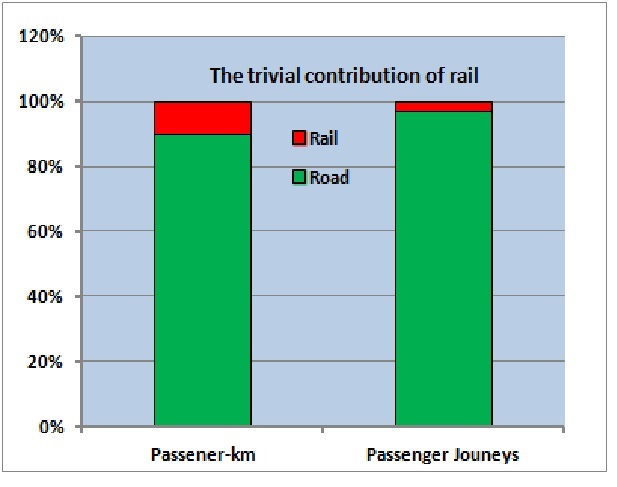
Lastly – here is a diagram illustrating the trivial nature or rail’s contribution to the nation.untitled

Outside London a rail journey is a rarity. Meanwhile all London’s crushed surface rail commuters could have seats in express coaches at less than one quarter the cost of the train. Those coaches would occupy around one seventh of the capacity available if the railway were paved, offer journey times better than the train’s for all but the longest journeys, whilst using half the fuel…… See the text, map and pictures here http://www.transport-watch.co.uk/topic-15-london-waste-battersea-and-north-marylebone etc. and Facts Sheet 5 here http://www.transport-watch.co.uk/facts-sheet-5-fuel-and-emissions-trains-compared-replacement-express-coaches-and-lorries-november-20

Best

Paul Withrington BSc MSc MICE C.Eng.

HS2, the deficit and integrity

In this note all references to HS2 are to the network out to Leeds and Manchester.  Financial data are at the 2011 price and discount base except where stated or obvious from the context.

The deficit

Cancelling HS2 would reduce the deficit otherwise arising by £4-£5 billion every year for 15 years, let alone the losses thereafter.

Integrity.

The Willingness to pay calculus

The so called “Willingness to Pay Calculus” used to “justify” HS2 compares the vast financial loss with the supposed social benefits. The same theory could be used to support every loss-making enterprise in the land; a high-speed way of bankrupting the nation. It’s barking mad, or more bluntly, a fraud on the nation. See here

Instead the decision should depend on common sense. Namely, if it makes a loss, especially one in the tens of billions of pounds, DO NOT BUILD IT. 

(If, for perverse reasons, they must do this cost-benefit analysis, they should compare the resource costs with the supposed benefits. For HS2 the resource costs amount to £62 billion. Subtracting fares from those costs provides a loss of £31 billion, halving the cost to Government. Hence, using resource costs, the £62 billion, instead of the financial loss or cost to government, £31 billion, would double the cost appearing in the benefit to cost ratio, destroying the case for HS2 at a stroke).

How big is the loss?

The actuarial loss from the network out to Leeds and Manchester, faced by those standing in the opening year, 2033, will be close to £70 billion at 2011 prices, not counting the cost of links to the HS2 stations etc. and supposing the fares come in as forecast, and the cost does not escalate out of sight, as with other rail schemes.

Here note (a) HS1 carried one third of the originally forecast passengers (b) the West Coast Main Line Modernisation Programme was at least four times over the original estimate (c) the cost of electrifying the Great Western seems to have doubled.

The (vanishing) user benefits

The user benefits put forward by HS2 Ltd amount to £59.8 billion see table 11 of the Economic Case for HS2, October 2013. Half are from savings in train time. However, it turns out that time on a train is spent nearly as productively as is time in an office. Similarly, we suspect non-working time (commuting and leisure) on a train is enjoyed as much, or nearly so, as is time spent anywhere else. Why else does the rail industry advertise for days out by train? Hence half the user benefits should be struck out. Another £12 billion (20%) of benefits are derived from peculiar sources, e.g.:-

  • Improved reliability, £5.50 billion, as though they cannot make the trains run on time without building a vastly expensive high speed rail network.
  • Reduced walking, £1.33 billion, overlooking that the trains are up to 400 metres long.
  • Better interchange, £4.15 billion, again ignoring the train lengths, and in any case why would interchange be better.
  • Better access 1.15 billion. Ha, Ha. All of these should also be struck out.

The remaining benefits would then amount to less than one third of those pretended to by HS2 Ltd.

Wider economic benefits, the WEBs

HS2 Ltd claim these will amount to £13.3 billion over the 60 year evaluation period.  However, the firm studiously ignores the damage done to the economy by the vast subsidy this scheme will require.

For example, the scheme is supposed to generate 100,000 jobs. However, with a financial loss of between £70 billion and £100 billion the cost per job amounts to between £700,000 and £1 million, or the lifetime wages of a working man. How many jobs will that destroy in that part of the economy which makes a profit?

KPMG claimed WEBs of an astounding £15bn per year. These can only come from generated business and commuting trips. If KPMG’s £15 billion is to be believed each generated round trip for those purposes would have to produce nearly £4,000, which is ludicrous see here, but apparently swallowed whole by the Government and the Transport Committee.

Transforming the economic geography

It’s a commonplace for Ministers and HS2 Ltd to claim that the scheme will transform the economic geography of the nation. However, whatever the transformation may be, it can only be derived from generated trips, since the transformation from existing trips is clearly already with us. Well, generated trips amount to only 1.5% of all surface rail trips and to only one in 2,000 of all passenger journeys. How on earth can that be transformational?

Percentage on business

Between January 2012 and October 2013 the value of business time, accounting for the majority of in-train benefits, was reduced by 30%, costs were increased by 20% and passenger forecast decreased by 15% yet the benefit to cost ratio was substantially unchanged. How on earth was that achieved?

Answer, among other, by shamelessly inflating the percentage on business far above the previous value or that available from survey data, exploiting the fact that business time is five times as valuable as other time. Here note that savings in business time account for £40bn amounting to 66% of user benefits.

Conclude

This scheme is a huge loss-maker for the nation. Its effect has been shamelessly misrepresented to the Government. Our view is those responsible should be prosecuted and the scheme abandoned with immediate effect. How else may the nation secure honesty in future proposals put forward by lobbyists?

Rail in crisis

Announcing a public meeting

Keynote speakers Dr Richard Wellings, Deputy Research Director, IEA and Paul Withrington, Director, Transport-Watch.

Q&A and networking.

6.30pm for 7pm until 9pm – Wednesday 17th May – Conference Room of St James’s Church Piccadilly. (entrance to meeting in Church Place W1J 9L

Who should attend:

  • All taxpayers – rail is costing every household in the land at least £200 per year, most of them seldom use a train.
  • The Government – wishing to reduce public expenditure.
  • Objectors to HS2, a vastly expensive project certain to make losses for the nation in the tens of billions of pounds.

Background here http://www.transport-watch.co.uk/topic-103-events-rail-crisis

OPEN TO ALL.

(If expecting to attend please text Jasper Tomlinson on  07785 551068)

Use of business time

January 2017

Summary

We all knew that people worked on trains.  This note goes further.  It cites a report by Mott MacDonald, commissioned by the DfT, and one by Microsoft.  Taken together, those reports show that business time on a train is almost as productive as time spent in an office.  The implication is that the value of in-train journey time savings for business passengers should be set to zero, destroying the economic case for HS2 at a stoke.

The Mott MacDonald report[1]

The Mott MacDonald report of June 2009 with the title, “Productive Use of Rail Travel Time and the Valuation of Travel Time Savings for Rail Business Travellers” was commissioned by the DfT.  The report provides:-

  • At page S-2, “It was found that the proportion of business travellers working on the train was, in Spring 2008, 82% for an outbound journey, and 77% on the return journey, a significantly higher value than the figure of 52% obtained from the National Passenger Survey (NPS) in Autumn 2004, the last comparable dataset. For those that spent some time working, the percentage of journey time spent working was 60% on the outward leg, and 54% on the return leg. For both directions combined, this corresponds to 46% of journey time by all business travellers being spent working”
  • At page S-3, “In economic appraisal, if work is done on the train, it has to be appraised in terms of the working time needed were that to be done in the usual office environment. The SPURT surveys showed that some two-thirds (68%) of working business travellers would take “about the same” amount of time, 8% would take “more” time (on average 29 minutes more) and a quarter (24%) would take “less” time (on average 18 minutes less). Across all journey lengths a slight saving of 1.7 minutes per journey would be realised in the usual workplace as compared to the train, this corresponds approximately to a 97% efficiency of working on-train compared with at-workplace”

Hence nearly 45% of business in-train time is used effectively.

The Microsoft report

The Times, 5th Oct 2015, reports a study by Microsoft.[2]  It found, “Employees waste three hours of every shift and only half of the normal working day is productive”.  The implication of that, together with the findings in the Mott McDonald report, is that time in an office is no more productive than time in a train.

[1]  https://www.gov.uk/government/uploads/system/uploads/attachment_data/file/4003/productive-use-of-travel-time.pdf

[2]  http://www.thetimes.co.uk/tto/news/uk/article4576147.ece,

HS2 forecasts – the government’s response to the House of Lords committee

The Government response to the House of Lords Economic Affairs committee, Cm 9078, says at paragraph 2.14, “Over 90 million passengers are expected to use HS2 each year once the full Y-network is complete – not just a few business people. Phase One is expected to carry 138,000 passengers a day, rising to over 300,000 passengers a day in 2036 after Phase Two opens and the full Y-network is complete”.

Well, 300,000 per day equates to 150.000 each way. They would require 150 one-thousand-seat trains or 12 per hour over 12 hours or a 1,000-seat train every five minutes with every seat taken, which is ludicrous.

After all, Virgin West Coast carries an average of only 200 passengers per train and the East Coast, 244 providing an average of 220 representing 56 million passenger journeys per year or 190,000 per day, not all of which would have one end in London. (Source, Office of Road and Rail statistics).

Why on earth does the Government believe this nonsense? It’s not as bad as the £15 billion benefits per year from the scandalous KPMG report but it is in the same league.

(The KPMG figure implies every generated business plus commuter trip yields £1,860 or £3,700 per round trip. To appreciate how ludicrous that is note that the £1,860, if applied to existing business plus commuter rail trips, would generates £1,500 billion pa equal to the nation’s entire GDP. If only that were true building a railway may rescue the nation. Instead the railway takes massive subsidy from the taxpayer every year).

The forecasts for HS1 were three times too high.  Perhaps the forecasts for HS2 would be more realistic if the executives, senior staff and their consultants were liable to prosecution, if the forecasts proved wildly wrong, as would arise if the matter were in support of a share offering.

Greener journeys

Claire Haigh, Chief Executive, Greener Journeys, has a piece in the Transport Times blog of January 2017 which suggests buses are a solution to congestion, air pollution and all indicating a startling a lack of knowledge.

  • A so-called green bus, presumably electric powered, will emit as much, or more carbon than, a diesel one once the emissions from power stations are taken into account.
  • Heaven knows the environmental impact of disposing of all those lithium-ion batteries. Incidentally the battery of the hyped Tesla weighs half a tonne. So, in city conditions its fuel consumption, on account of stop and start, may be massive.
  • A diesel car designed to pass the tests imposed on lorries and buses would emit a fraction of the NOx currently emitted by such vehicles. The target should be an appropriate change in the legislation.
  • There is no more environmentally damaging vehicle than a subsidised bus lumbering around with a couple of passengers aboard – except perhaps a train.
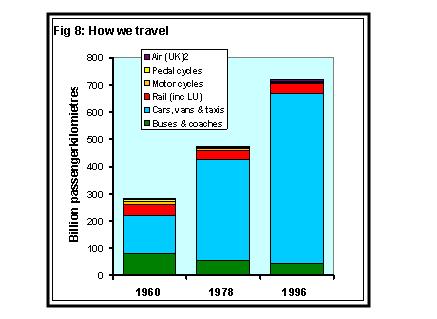
  • The idea that congestion can be solved by transferring a significant proportion of passenger journeys from car to public transport is unsustainable, see the first diagram below. It is from John Prescott’s white paper, “A New Deal for Transport: Better for everyone” Cm 3950, July 1998.  Obviously increasing bus and train use by e.g.  50% would have at best a marginal effect on cars.  Presumably Prescott and his advisors had no idea what the diagram implied.  If they had, the policy would not have been so idiotic.
  • The second diagram, taken from Cm 7176: Delivering a Sustainable Railway, July 2007, when Ruth Kelly was the Sec of State, illustrates the trivial effect that transferring a few handfuls of people from car to public transport could have on carbon emissions. Despite that they continue to bleat about transferring people out of cars etc.
  • A hydrogen powered vehicle is pure nonsense. Readers may not know it but there are no hydrogen mines.  Instead manufacture takes lots of energy and the gas is so volatile that it is nigh-on impossible to store.  It’s then bunt in an internal combustion engine which may be little more efficient than a diesel.
  • (Burning wood chip is probably worse than burning coal. The wood chip would otherwise take decades to rot and give off its CO2 in which time other growth would absorb the same.  Burn it and find some more trees to burn …….).

So, I ask, who needs enemies when we have ignorant people like Clair Haigh, Prescott, Ruth Kelly and the rest of those Secretary of States, through to Philip Hammond, Patrick McLoughlin and Chris Grayling, along ,with their advisors, making “policy”.

Ms Haigh will be speaking at the Transport Times Conference, the UK Bus Summit on the 9th February in London – a seminar costing £195, thereby debarring all but the wealth or those on expenses.

Third runway noise impacts

These notes follow from the Airports Commission’s report, Business Case and Sustainability Assessment – Heathrow Airport Northwest Runway, July 2015.

Our conclusion is that the damaging effect of aircraft noise has been grossly underestimated and that the social cost may destroy the business case for the third runway.

The Commission’s report.

Paragraph 3.55 of the Commission’s report provides:

“The noise contours and population estimates in the local assessment have been used to monetise the noise impacts at Heathrow, for inclusion in the economic appraisal. The effect of noise in terms of annoyance, sleep disturbance, acute myocardial infraction (AMI) and hypertension on the Quality Adjusted Life Years (QALYs) of the population living within the noise contours have been considered. These calculations are based on World Health Organization (WHO) Environmental Burden of Disease guidelines and the ERCD report 120930. This approach values the noise impacts by estimating the number of years of life lost or spent with a disability, to get the number of QALYs lost, and uses established values for each QALY lost to arrive at the total monetised noise impact. The quantified and monetised impacts of noise cannot fully reflect people’s individual experience of noise. Some of the qualitative impacts are discussed in the Noise section, and the Quality of Life assessment also includes noise impacts on peoples’ wellbeing”.

And at Para 3.56 “The noise impacts with Heathrow Airport Northwest Runway in the Commission’s assessment of need carbon-traded demand scenario is £1 billion (PV, 2014 prices). This figure does not take into account the Commission’s recommendation to end scheduled flights in the core night period between 23:30 and 06:00”.

We comment; the £1bn represents the loss from the 60 year evaluation period. It equates to less than £100 per flight, or to fractions of a penny per person per disturbance. All those values seem entirely trivial.

In any case, the use of “QALYs” is at variance with transport studies where time saved or lost is the metric, a metric which can be criticised since time on a train or when travelling generally is not lost in the pure sense. Instead such time may be used and enjoyed, e.g. working, reading, resting or simply enjoying the passage. In contrast, noise from an aircraft may completely destroy the effective use or enjoyment of time.

In the following we make estimates of the financial loss to those on the ground using a time loss approach. In principle we multiply the Air Traffic Movements (ATMs) by a disturbance time, the value of time and by the number of people disturbed. That provides an annual cost which may be summed and discounted in the usual way to represent the Present Value of the lost time for comparison with the scheme’s benefits. The price and discount base is 2014.

Paragraph 2.9 of the Commission’s Report says that there are currently circa 470,000 Air Traffic Movements pa at Heathrow, close to capacity. Para 2.19 provides a limit with expansion of 740,000 ATMs – presumably as a result of the new runway. The implication is that the runway enables an additional 270,000 ATMs. We will use 250,000 in calculations. If those are spread over the year and over 16 hours a day we have roughly one ATM every 1.5 minutes. That may represent a minimum disturbance duration due to overlap. A maximum may be 5 minutes, allowing two for the over-flight and three to refocus, but only if there were fewer ATMs.

The HACAN clear skies blog provides the following:

“The numbers under the Heathrow flight paths are well-known: currently over 725,000; a third runway would add around another 150,000. What is much less clear is how many of these people are, or will be, deeply disturbed by aircraft noise.  However, there is some research to help us find that answer. It is estimated that about one in ten people are particularly noise-sensitive. According to the German psychologist, Rainer Guski, these people are likely to become more annoyed by noise than the general population”.

Hence a starting point for calculations is a population of 150,000.

In calculations we use the DfT WEBTAG discount rates of 3.5% for the first 30 years from the base year (2014) and 3% thereafter, a value of time consistent with “other” non-working time, at £6.81 per hour for 2014, and a growth factor of 2.1% pa; all consistent with the DfT’s WEBTAG data book. We set the opening year to 2026, as reported.

On that basis the discounted value of disturbing 150,000 people for 1.5 minutes for 250,000 ATMs pa for 60 years amounts to £270 billion, vastly more than the £1 billion provided by the Commission.  The spread sheet containg the detail is avalable via http://www.transport-watch.co.uk/cost-aircraft-noise

If each ATM affects only one third of the people in the noise envelope at any time (due to varying flight paths etc) then the loss on the ground falls by a factor of three to £90 billion.
If, at one extreme, there are those who lose no focus at all and at the other there are those who lose the full 1.5 minutes, according to noise sensitivity, then, instead of a £270 billion, or £90 billion loss we should halve those values to £135 billion and £45 billion. If the £45 billion is the more realistic number it may then be halved, on the basis that the use and enjoyment of time is never completely destroyed. Even then the value lost, £22.5 billion, would be overwhelming. It would reduce the net present values in the Commission’s report table 3.23 (ranging from £1.4 billion to £11.8 billion) to heavily negative numbers, namely, and after adding back the study estimates of the impact of noise, to the range minus £19.6 billion to minus £9.7 billion.

Possible criticisms of the above include (a) properties may be insulated, so mitigating the effect, to which we rejoin, windows may then never be opened (b) people may adjust, to which we rejoin – some will, some will not; in any case, at what cost.

Conclude

The value of time lost on the ground, due to aircraft noise, may be very much greater than the net present values estimated by the Commission’s economic analysis. The effect may be to destroy the business case for the third runway.