
Climate change is providing a pretext for all manner of restrictions on our lives. As a consequence, climate change policies are now one of the biggest threats to individual freedom.
There is good reason to believe this is at least partly deliberate, that the climate change agenda is a Trojan horse for more sinister ends: socialist-style central planning of the economy, dictatorial global government, and grabbing a greater share of assets and resources for transnational “elites.”
This context explains why the flaws of the official climate change narrative are rarely debated. They are largely ignored by tightly controlled media outlets and the seemingly bought-and-paid-for scientific establishment.
The standard narrative says climate change is a major threat to civilisation. A “scientific consensus” suggests it will lead to “extreme weather” – stronger hurricanes, worse flooding, droughts and forest fires.
This will destablise society, it is claimed. Parts of the world will no longer be able to support agriculture. Food and water shortages will worsen, leading to migration on an epic scale. Even relatively resilient countries face huge costs to strengthen flood defences, adapt essential infrastructure and so on.
An obvious flaw is how this perspective neglects or ignores potential benefits from climate change. Global warming could reduce heating bills and winter deaths in cold countries. Raised CO2 levels tend to increase crop yields. Higher rainfall could be helpful in many locations.
It is not obvious that the costs of any climate change will outweigh the benefits, or if they do, by how much. In any case, it is disingenuous to argue these costs and benefits can be properly quantified. They are highly subjective at the individual level and therefore hard to measure, monetise and aggregate. This is highly problematic when trying to set policy in a rational way or determine optimal temperature targets.
Scientific modelling provides a crutch for the policy activists. But the record of both climate and economic modelling is appalling – including over the short run.
And even if short-term success were achieved, this would not guarantee long-term accuracy. There are numerous factors that modellers cannot know, such as the impact of unpredictable natural events or sudden advances in technology – or indeed individuals’ preferences decades in the future.
Climate change activists perhaps have a more compelling argument when they argue that this lack of knowledge is a major reason why humanity should be worried. If the models were reliable, then people would have a good idea what’s in store and could take steps to address the problems. But the inherent uncertainties mean catastrophe is possible.
The chances might be slight, but climate change could wipe out much of humanity, perhaps because unknown positive feedbacks occur or certain tipping points are breached. From this perspective, the lack of knowledge provides a rationale for caution.
Norman et al. write:
“Without any precise models, we can still reason that polluting or altering our environment significantly could put us in uncharted territory, with no statistical track record and potentially large consequences.” …
“It is the degree of opacity and uncertainty in a system, as well as asymmetry in effect, rather than specific model predictions, that should drive the precautionary measures. Push a complex system too far and it will not come back. The popular belief that uncertainty undermines the case for taking seriously the ‘climate crisis’ that scientists tell us we face is the opposite of the truth.”
However, while the nature of the uncertainty and opacity are not the same, there is also a lack of knowledge about the impact of policies designed to tackle climate change.
To paraphrase the above quotation, without any precise models, we can still reason that altering our economy significantly could put us in uncharted territory, with no statistical track record and potentially large consequences.
Climate change policies are already undermining productivity growth in many countries. The process by which living standards increase due to big reductions in energy and transport costs has been choked off.
Climate change is also providing a pretext for trade barriers, with industries in Europe resenting “unfair” competition from countries with looser environmental standards.
Then there’s the increasing state control of the economy, with major sectors centrally planned by government bureaucrats. Think of the forced shift to renewable energy and electric cars, or state meddling in agriculture.
All this promotes economic stagnation or decline. In turn, it could create a vicious circle, with interest groups lobbying more intensively for government favours as the size of the pie shrinks – a negative sum game compounding the damage.
Look how heavy industry in Western Europe, crippled by high energy prices, has been propped up by state subsidies to keep it alive, or how growing fuel poverty is putting pressure on the welfare state.
It’s possible to envisage climate change policies pushing the political culture in a far more socialist direction in reaction to social and economic problems caused by the radical green agenda (difficulties which will, however, be blamed on convenient scapegoats, such as an imaginary “free market”).
Climate change policies could therefore be a monumental disaster for the economy and society, threatening key drivers of wealth creation such as trade, economies of scale, and specialisation.
This would bring big declines in living standards, perhaps even disasters similar to those predicted by climate change alarmists, such as large-scale starvation and population displacement.
While it could be argued that economics is less uncertain than climate change, the outcome might also depend on highly unpredictable combinations of economic decline, reduced resilience and “external shocks” such as war, natural disasters or pandemics.
It is also conceivable that ill-conceived climate change policies could end up reducing resilience to climate change itself (natural and/or human-influenced), with catastrophic outcomes resulting from a combination of both. The uncertainty could thus be compounded.
The policy implications are clear. Climate change measures that create major economic uncertainty by damaging fundamentals such as individual freedom, property rights, wealth creation, productivity growth (and thus food availability) should be discarded. The focus instead should be on win-win policies that benefit both the economy and the environment. These are measures that should be implemented whether or not climate change is viewed as a serious threat.
This means phasing out the vast and inefficient state subsidies to activities that emit “greenhouse gases,” such as non-viable agricultural practices, elements of the fossil-fuel industry, loss-making parts of energy and transport networks, and much of the military.
Government theft of land, often on behalf of crony-capitalist corporations, should also cease. Property rights should be respected, including those of various indigenous peoples whose form of ownership might differ from current European norms.
State control over vast swathes of the planet is illegitimate. It took place through violent conquest without the consent of the original inhabitants. A policy of non-interference, combined with returning these areas to their rightful owners and ending state subsidies, would prevent much of the damage to ecosystems that bolster the resilience of the planet. Economy-killing climate policies would then be even less defensible.
Richard Wellings
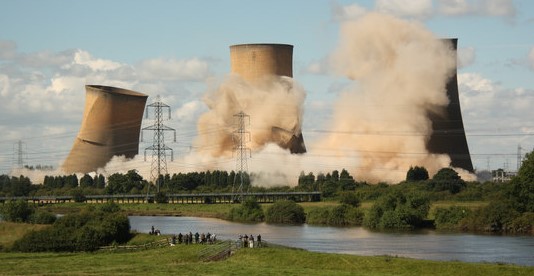
Image: Croft, R., Wikimedia Commons, CC2.0.
 Transport Watch