Political manipulation and the push for climate lockdowns

The plan is clear. The political elite want to create what amounts to a new feudal system, with the manipulation of the green agenda providing a convenient pretext.
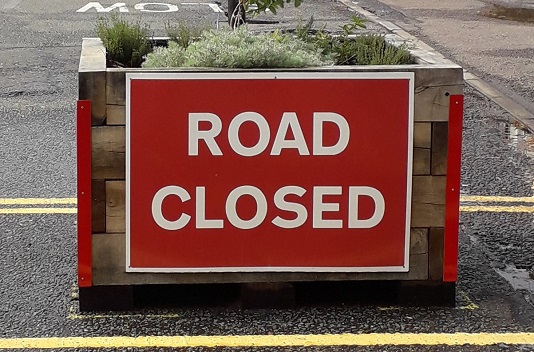
Ordinary people’s mobility will be severely restricted. They will be forced out of their cars and off the roads by a raft of new charges and controls. Their lives will largely be confined to “15-minute cities.”

But the perpetrators have a problem. These measures are deeply unpopular with a large percentage of the public. And they are being imposed in ostensible democracies. So, they need a strategy to overcome resistance.

One element is a relentless propaganda campaign to promote the idea of a “climate emergency.” With clear parallels to the manipulation strategies deployed during the pandemic, they’re trying to persuade the public that a form of lockdown is necessary to stop global warming.

This is why the BBC lectures viewers on climate change every time there’s a heat wave, flooding or forest fires. It’s also why the BBC has effectively banned proper debate on environmental issues, with sceptical voices not welcome on its outlets. The understandable anguish created by images of natural disasters is used to undermine free speech on the issue.

The second element is a focus on local government. There’s a reason why mayors and councils are taking a leading role in the “climate lockdowns” policy, while central government pretends to be more motorist friendly. The establishment is exploiting the different incentives facing members of the public.

The benefits of measures such as “low-traffic neighbourhoods” (LTNs) are highly concentrated and obvious to the relatively small number of beneficiaries. By contrast, the costs, which may be enormous by comparison, are typically dispersed and not always obvious to the losers.

If a through road is closed off by the council, many of its residents will support the new restriction (though some may be against – for example if it means much longer journeys). Their street may be quieter and perhaps safer. This constituency offers a bedrock of support for such measures.

It will be bolstered by locals ideologically wedded to the green agenda, perhaps the result of a lifetime of indoctrination by schools, universities and the media, with no exposure to the counter arguments.

They will be joined by state-funded “sock puppets” – campaign groups paid by government to lobby itself and create a fake impression of wider support for policies that the political elite have already decided to impose.

By focusing on the local level, the instigators can build a sufficient coalition of supporters to at least make the argument that they’re not imposing their agenda despite overwhelming public opposition.

Indeed, many of the losers from such policies will not even live or vote in the borough or city where the new controls are being installed. They may be commuters or businesses now facing prohibitive charges or massive delays to their journeys.

Residents in areas beyond the schemes may see a big increase in congestion as traffic is displaced. The emergency services might become less efficient as they can no longer take a direct route, or because cycle lanes mean motorists can no longer get out of their way to let them pass. Labour mobility, productivity and wages may decline because potential employees can’t reach jobs that match their skills, and economies of scale may be lost as the populations that can be profitably or efficiently served shrink (click here for a more detailed discussion).

It will not always be obvious to people that the “war on motorists” is to blame for these negative economic impacts, which in turn dilutes political resistance to the new restrictions. And these effects are spread over a much wider geographical area than the benefits (that accrue to a small, concentrated group), which means opposition is harder to coordinate.  

Note that the purported non-local environmental gains are quite tenuous. The costs and benefits of any future climate change are impossible to calculate accurately. And the impact of the new controls will be negligible in terms of global emissions. In any case, anti-car policies are often counterproductive. Artificially created congestion can actually increase pollution.

Rather than restricting ordinary people’s mobility – and effectively creating a new feudal system in the process – policymakers should focus on win-win policies that both cut emissions and benefit the economy. This means ending the vast subsidies pumped into various polluting activities.

It speaks volumes that governments are so reluctant to take this obvious step. The green agenda is really about giving even more power to the elite and their institutions rather than saving the planet.  

Richard Wellings
Why the UK needs the Rotodyne and not HS2

The massive investment required by HS2 is wasteful and will provide a very limited set of benefits. This article argues that a better use of funds would be the creation of a compound gyroplane fleet and rooftop landing sites in certain areas of some cities.

The first point to understand is the physics of high-speed transport. An object moving at twice the speed requires four times the energy. An object moving at four times the speed needs sixteen times the energy.

Thus, a train at 300 km/h is sixteen times more energy greedy than one at 75 km/h, which also should explain to the non-engineers and non-scientist minded why freight trains travel so slowly. High-speed rail is the very opposite of energy efficient. Electric high-speed trains travelling at 300 km/h+ are some of the worst energy guzzling machines we have.

The merit function for high-speed rail puts journey times and city centre to city centre connectivity as high priorities, far above energy efficiency, landscape preservation and flexibility.

For any pairing of cities that does not include London, this project is a bust. Yet the entire country is forced to pay for it.

What worked in Japan was a curious mix of ultra-high population density linked with a small number of population centres on flat plains.

In the UK, with its rolling countryside and older tracks, the 200 km/h tilting Advanced Passenger Train (APT) (although a victim of politics) was the only sensible choice. It exists today as the Pendolino, built under licence from Italian firms within the UK, but mostly abroad.

To create high-speed connectivity for the subset of passengers who require that option every day, the compound gyroplane is a very good choice. This can serve any two points within the UK in a maximum of two hours – not dissimilar to a stratosphere cruising jet, but without the need for expensive airport infrastructure. If the take-off areas are secure, then such a vehicle can even land on rooftops in the City of London.

The compound gyroplane would work for any and every type of person, in every area of the UK, while being a massive export earner and long-term job creation scheme.

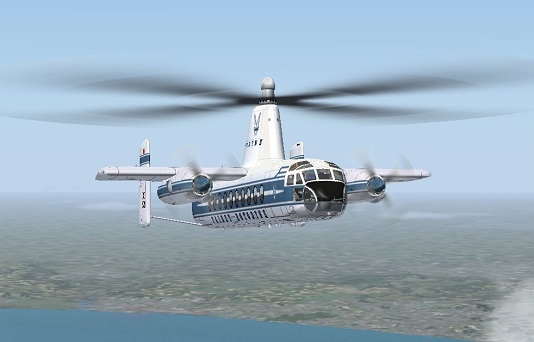
The Fairey Rotodyne was an aircraft developed from 1956 to 1962 by the UK aeronautics company Fairey, later merged with Westland. It was a compound gyroplane with propellers and a large main rotor which was operated by “tipjets” – small combustion engines at the extremities of the rotor which provided a jet thrust to move the rotor for take off and landing. The main rotor itself was otherwise unpowered and it would freewheel in flight, providing lift.

This article examines the potential benefits of the craft in terms of providing an addition to the transport options in the United Kingdom. In order to assess these, it is important to engage in some analysis of existing transport modes and their benefits.

The physical geography of the United Kingdom is similar to Japan and New Zealand – a long, thin archipelago. However, the population distribution on the main island, Great Britain, does not lend itself to the construction of high-speed rail in anything but three operational axes which are economically viable. 

The high quality and high speed of the East Coast and West Coast mainlines mean that a good enough quality of travel can be obtained there. Going any faster than 140 mph (225 km/h) is not optimal, due to the energy use and increased cost.

A faster service could be obtained for the comparatively small number of customers who really need to go from London to Newcastle in under 1 hour by using helicopters or small aircraft. At a similar price point to the business class ticket on the high-speed rail system, there is a niche that can be met by use of a hybrid helicopter/aeroplane, which could thus also link the island of Ireland, Isle of Man, Isle of Wight, Scilly Isles, Inner and Outer Hebrides and Faroes. Charter services could perform multi-city stops and hops.

Travel options matrix

The variables we wish to examine are: speed, cost, capacity, energy efficiency and distance.

High-speed rail occupies a specific niche of the transport equation – high speed, high cost, low energy efficiency and medium capacity. The sweet spot for this mode is long distances between 150 and 600 km with large (100+) numbers of passengers.

Low-speed rail is low speed, relatively low cost, highly energy efficient and is almost always high capacity. The distance of this mode of travel is anywhere from 50km to 1000km. From 50+ passengers.

Minibus/coach travel is the lowest cost, highest capacity, low to medium speed, medium energy efficiency and very flexible. The distance of this mode of travel is anywhere from 50km to 1000km. 20+ people. Linking islands is only possible with the use of ferries.

Car travel is medium cost, medium speed, low capacity, low energy efficiency and the most flexible of all the ground transport options. The distance of this mode of travel is anywhere from 3km to 1000km. Linking islands is only possible with the use of ferries

Aeroplanes are the highest speed, high cost, inflexible and need long distances for the cost-benefit analysis to make sense. They are only efficient (in both terms of cost and energy) with very large numbers of people and somewhat medium to very long distances. Apart from flights from the South of England to Scotland, Ireland or the North of England, this is not a viable option for intra-UK travel.

Helicopters are the highest cost, most flexible form of transport in the UK, though of very low capacity and abysmal energy efficiency. More versatile in terms of places that can be reached and at speeds comparable with high-speed rail, they are nevertheless almost prohibitively expensive for anything but occasional use. They are not a commuting option.

Within this matrix, there exists an unmet niche: that of high speed, medium to high capacity, low to medium cost, with flexibility comparable to helicopters.

Enter the Rotodyne compound gyroplane.

Eric Matthew W. Masaba

Image: Rotodyne 2 by L. Chatfield, Flickr (CC by 2.0), cropped.