
The government used the pandemic as a pretext to intensify the “war on motorists”, a key element of the elite’s Build Back Better agenda.
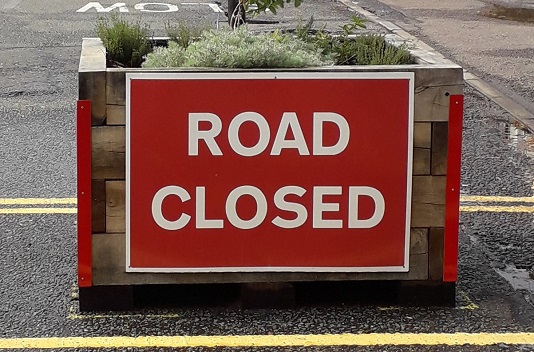
Councils were paid to close vast numbers of streets to through traffic, often as part of so-called Low Traffic Neighbourhood schemes. Main roads were narrowed and cycle lanes expanded. Punitive new charges were imposed, in particular London’s Ultra Low Emissions Zone levy, and there are now plans to roll out similar schemes to other cities.
These draconian measures made little sense in terms of the Covid-19 narrative. If anything, car travel should have been encouraged to reduce the spread of the disease. Instead, these policies almost certainly forced more people to use public transport than otherwise would have been the case – despite the apparent infection risks.
Government mismanagement of the pandemic also had a devastating impact on the economy. A massive state spending binge, combined with central bank money-printing on a huge scale, contributed to a cocktail of soaring inflation, a cost-of-living crisis and ballooning public debt.
The obvious way out of this predicament is to adopt policies that facilitate robust economic growth. This would increase tax revenues without a harmful rise in tax rates, thereby mitigating the government debt issue. It would also tend to increase real wages, addressing the cost-of-living problem.
The key to generating growth is rising productivity. But today many government policies seem to be deliberately designed to reduce productivity and undermine improvements in living standards. The war on motorists is a prime example.
A series of measures seem deliberately designed to increase congestion. These include a big rise in the number of traffic lights; the narrowing of junctions to reduce flows; the reduction of road space to make way for bus and cycle lanes; the widening of pavements; and the closure of through routes.
The resulting traffic jams lead to major productivity losses, with drivers wasting time sitting in their vehicles and burning fuel while stopping and starting repeatedly. While it is hard to put a precise figure on the resulting costs to the economy, estimates for losses from congestion in the UK are as high as £40 billion a year.
But the negative impact of anti-car measures goes far beyond this. Journeys are delayed even when there is no congestion. Motorists are stopped by traffic lights even in the middle of the night when the streets are empty. They have to crawl along at 20mph in boroughs where speed limits have been slashed. They have to take long diversions where through roads have been blocked off in so-called low-traffic neighbourhoods. And they have to drive around finding somewhere convenient to park because the council has restricted the number of spaces.
The impact of all this on productivity is especially obvious in the cases of delivery drivers and tradesmen. A delivery driver can make fewer deliveries in a given amount of time due to the artificial delays and diversions. A plumber or electrician can make fewer repairs due to the additional time required to travel between jobs.
In addition, the productivity of the retail sector is negatively affected. Because it takes longer to travel to a given outlet, shops will tend to be smaller, serving a lower population, thereby reducing economies of scale and efficiency. The delays will have a similar impact on distribution, favouring smaller and less efficient warehouses rather than larger, more efficient ones a greater distance apart.
Employment opportunities are also harmed. If a potential worker is prepared to commute for an hour each way, then the delays will reduce the size of the area in which he or she is prepared to take a job. With fewer options available, workers are less likely to find employment that is a good match for their skills – an outcome that again will tend to reduce productivity.
Similarly, businesses will have a smaller pool of potential workers available. They may struggle to find the right people. An entrepreneur might decide to build a smaller and less-efficient factory because the number of suitable workers within its catchment area is lower than otherwise would be the case. And clusters of expertise, together with associated competition and innovation, will tend to be negatively affected due to the shrinkage of the talent available in any given location.
The negative effects on labour mobility will of course be multiplied if the war on the motorist leads workers to abandon car ownership entirely. Vast swathes of the country are poorly served by public transport, which typically isn’t viable outside urban areas with a high population density and core routes between cities. Commuting by public transport is often completely impractical in the outer suburbs, yet alone in rural areas.
This article has only scratched the surface in terms of the damage being done. The enormous impact of anti-car policies on ambulances and the other emergency services hasn’t been discussed, for example.
The big question is whether our politicians understand the scale of the harm they’re inflicting. Perhaps they think the ends of this draconian top-down agenda justify the means.
Richard Wellings
 Transport Watch