
Letter to Ben Webster, Environment Editor, and Graeme Paton, Transport Correspondent, at the Times, copied to the Secretary of State for Transport and the Minister:
Dear Ben and Graeme,
On 28th January Ben had a column with the laughable headline, “Track-side wind farms could power HS2 trains”, and on Thursday Graeme had an equally laughable one, “Solar trains timetabled to replace diesels”.
Laughable or not, the diagram below, from Cm 7176: Delivering a Sustainable Railway, July 2007. illustrates that, even if the entire railway could be run that way and even if the emission was then an impossible zero, the effect on the nation’s emissions would be vanishingly small.
Those columns of yours, and the nonsense about hydrogen power, do nothing but promote the quite false impression that the railways are uniquely green when nothing could be further from the truth.
Why do you waste your time on such trivia and to such damaging effect?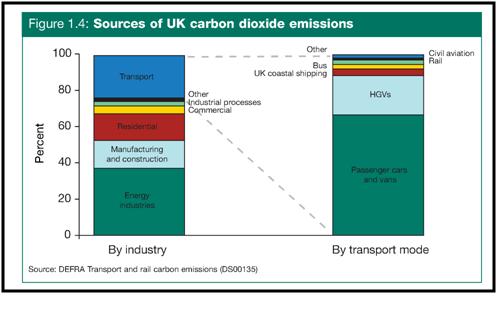 With regard to hydrogen; have you not noticed that there are no hydrogen mines! The bulk of the gas is made by “gas reforming” e.g. heating methane and steam to 700 degrees centigrade, thereby producing hydrogen and, yes, you guessed it, CO2, let alone the emission from producing the energy for the process.
Even worse – storing hydrogen is tricky, to put it mildly. At 10,000 psi, or roughly 700 atmospheres, a tank giving a range of 350 miles would be three times the weight and nine times the volume of a tank of diesel… There are, of course, “fuel cells” but I remain amazed that anyone seriously pursues this route – except perhaps as a publicity stunt, driven by subsidy voted through by those who do not know their arses from their elbows or their multiplication tables.
http://www.fsec.ucf.edu/en/consumer/hydrogen/basics/storage-compressed_gas.htm
Click to access task2_gaseous_h2.pdf
Lastly – here is a diagram illustrating the trivial nature or rail’s contribution to the nation.
Outside London a rail journey is a rarity. Meanwhile all London’s crushed surface rail commuters could have seats in express coaches at less than one quarter the cost of the train. Those coaches would occupy around one seventh of the capacity available if the railway were paved, offer journey times better than the train’s for all but the longest journeys, whilst using half the fuel…… See the text, map and pictures here http://www.transport-watch.co.uk/topic-15-london-waste-battersea-and-north-marylebone etc. and Facts Sheet 5 here http://www.transport-watch.co.uk/facts-sheet-5-fuel-and-emissions-trains-compared-replacement-express-coaches-and-lorries-november-20
Best
Paul Withrington BSc MSc MICE C.Eng.
 Transport Watch